Tata's Tiago EV Puts Spotlight Back On Affordability Of Electric Cars In India
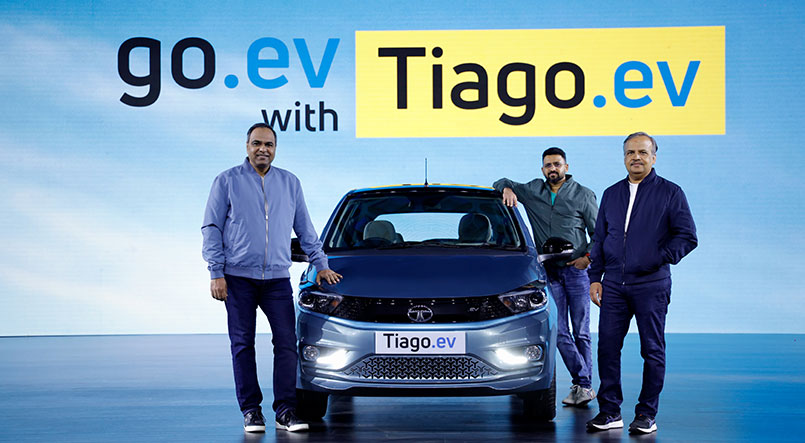
Tata Motors Ltd.'s launch of India's cheapest electric car, the Tiago EV, has put the spotlight on the affordability of battery-powered vehicles yet again.
The latest offering from India's third-largest carmaker has broadened the space and could be a major step towards encouraging mass adoption of EVs in India, at least from the perspective of pricing.
India's electric car segment has witnessed a spate of launches in the past couple of years but not enough to provide buyers with varied options at different price ranges.
In the Rs 8-13 lakh bracket, which is the most crucial price range for driving large-scale adoption of EVs, Tiago EV's entry has given the buyers a second option. But both products come from the House of Tata, the other being the Tigor EV.

The competition will heat up in the Rs 13-20 lakh range with entry of the Mahindra's 'XUV400', seen as a likely challenger to the Nexon EV, the industry's best-selling electric car.
The Rs 20-30 lakh price bracket also offers limited choices to buyers: the MG Motor India's 'ZS EV' at Rs 22 lakh and Chinese automaker BYD's 'E6' at over Rs 29 lakh.
There are no models available in the Rs 30-50 lakh price range, but there are few options if one is willing to pay more.
To be sure, pricing is not the only thing to watch for when buying an EV.
“There are two main ingredients to seal the deal on an EV—the price and the brand. When both meet at an ideal point, the buyer is convinced,” Ambuj Sharma, former additional secretary at the Union Ministry of Heavy Industries who closely worked to shape the government's incentives for battery-powered mobility, told BQ Prime.
“A typical customer is still unable to comprehend total cost of ownership of EV versus fossil fuel-powered vehicles and therefore is unwilling to pay higher upfront cost,” he said.
According to Sharma, it will progressively improve as battery costs fall and EVs cost almost same as conventional vehicles in three-four years. Brands, however, must innovate, increase R&D spends on batteries and achieve a certain scale of production to make it happen, he said.
“If you're demanding a higher speed and a higher range and performance equal to a diesel car, it is impossible to create a similarly priced electric vehicle for now,” Sohinder Gill, director-general at Society of Manufacturers of Electric Vehicles and the chief executive officer at Hero Electric Pvt. Ltd., told BQ Prime in August. “Either you have to reduce the performance, or you have to increase the price.”
But those are not the only concerns troubling potential EV buyers. Charging infrastructure is another crucial aspect for large-scale adoption of electric vehicles and it is not catching up as fast as everyone from the industry to the government would like to see.
“The lower you go in terms of battery capacity and pricing, the more range anxiety (real world) becomes a problem,” said Gaurav Vangaal, associate director at S&P Global Mobility. “For a reality check, just see the number of apartment societies that can actually accommodate charging stations.”
According to Vangaal, the low penetration of charging stations is the main reason electric vehicles may struggle to attract buyers beyond the enthusiastic early adopters of any new technology.
For the same reason, ‘clean vehicles' remain a new technology to try one's hands on, instead of a true mobility solution for people at large.
“Currently, the customers buying EVs are from relatively upper class willing to take risks and intend to use these vehicles as their second or third vehicle,” according to Arun Malhotra, auto expert and former managing director at Nissan Motor India Pvt. Ltd.
While pricing is a crucial factor, he said, ‘'the real litmus test'' of mass adoption will be how many buyers are first-time buyers and are intending to use it as their only vehicle.

-
AI Bias In Investing Cannot Be Eliminated, But It Can Be Governed

Framing is a particularly important example as identical financial information presented in terms of gains rather than losses can lead an LLM to reach a different assessment.
-
Joining The Dots | Dark Skies, Steady Diya: Why Hope Holds This Diwali
With war, a weak rupee and foreign outflows weighing on sentiment, policymakers at the NDTV World Summit and market veterans at NDTV Profit Ignite: Diwali Edition offered the same advice: stay invested and filter out the noise.
-
The Curious Case of Equitas Small Finance Bank And A CEO Who Quit For Stock
PN Vasudevan believes persistent investor concerns over a perceived conflict of interest had become a governance overhang on Equitas Small Finance Bank's stock, even as the lender improved profitability and asset quality.
-
Talking Points This Week: AI Cash Burn, A Tiger Comeback And An India That Still Finds Its Own Path
India is not immune to higher oil or tighter global liquidity, yet its earnings base is broader, its domestic policy levers are still available.
-
Foreign Investors Own Half Of HDFC Bank and ICICI Bank. An LTCG Cut Could Matter Most Here
Foreign portfolio investors have US$115 billion parked in HDFC Bank, ICICI Bank. If the government cuts long-term capital gains tax, Jefferies says returning foreign money could land here first.
-
'Never Seen This Level Of Negativity': Sandeep Tandon Says The Next Rally May Be Closer Than You Think
Veteran investor Sandeep Tandon says foreign selling is easing, large-caps are due a comeback and mid-caps are crowded, while he turns positive on gold, power and pharma this Diwali.
-
Indians Stay With Family, Not In Hotels | The Reason Why
India still lacks enough clean, reliable and affordable hotels for budget-conscious travellers.
-
The Economic Imperative: Analysing The Material Driving Force Behind India-Canada Strategic Reset
This economic complementarity is further reinforced by deep institutional investment ties and talent mobility, which form the bedrock of the bilateral framework.
-
Medicine Pricing: Where Must Profit Stop?
India must confront excessive margins, hidden incentives and regulatory gaps that threaten the integrity of medicine.
-
Why Amazon And Flipkart Are Struggling To Beat Meesho In India's Smaller Cities
With 274 million users and lowest-cost logistics, Meesho is defending its value commerce crown against giants like Amazon and Flipkart.










