Scan to Download

These measures may reduce yields, but they will certainly make mutual fund investments safer.Ajay Tyagi, Chairman, SEBI
Board felt that 5 percent restriction on royalty payment, as originally recommended by Kotak committee, is good enough.Ajay Tyagi, Chairman, SEBI
Tyagi said the regulator has taken a cautious approach with differential voting rights in shares. This is the first time this is being tried in India, he said.
There’s also a counter argument that corporate governance needs to be tightened, Tyagi noted, adding that SEBI has tried to address those concerns.
Tyagi said that the reglator has had wide consultations with the mutual fund industry about amending rules for valuation of debt securities. The industry is on-board with the amendments, he said.
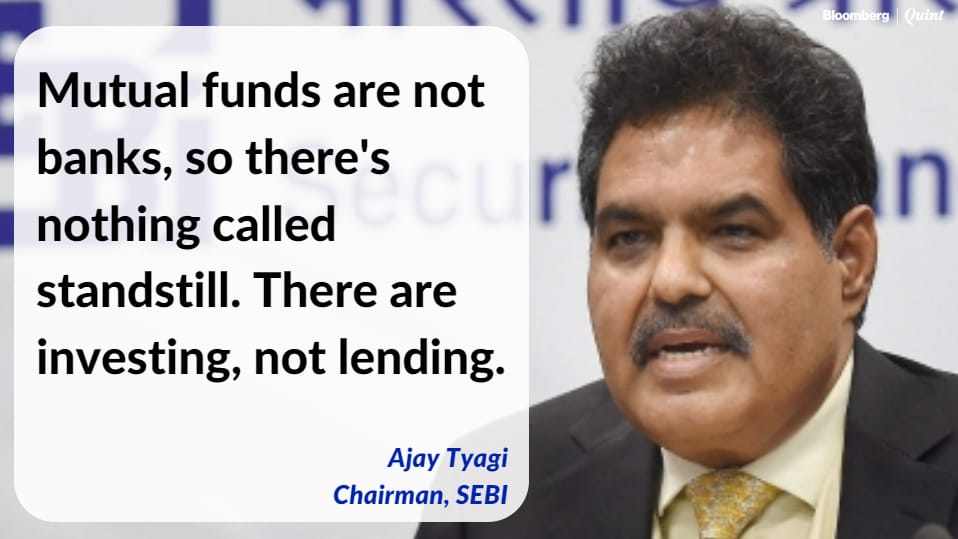
Investments by mutual funds are different from lending by banks and they need to balance safety and investment. Such investments have to be prudent, Tyagi said.
SEBI had constituted a working group to review its risk management framework for mutual fund schemes, in light of credit events in fixed income market that led to a increase in liquidity risk of mutual funds.
The regulator has approved the following proposals:
The definition of encumbrance has been broadened, said SEBI Chairman Ajay Tyagi.
Promoters will have to disclose the reason for encumbrance whenever their combined encumbrance crosses 20 percent of the total share capital or 50 percent of their shareholding, he explained.
The board of the Securities and Exchange Board of India is meeting today to decide on a variety of issues from clarifying norms on differential voting rights in shares to tightening disclosure norms for shares that are considered for pledging.
Tightening encumbrance disclosure by promoters of listed firms is on the agenda today with a growing number of cases in which share value declined sharply after defaults, with lenders scrambling to sell pledged shares.
The regulator already has a set of regulations for encumbrance disclosure. Yet, concerns have been raised recently with mutual funds’ exposure to debt and money market instruments through structured obligations, pledge of shares, non-disposal undertakings, related party transactions or promoter guarantees.
According to Crisil, the total value of shares pledged by promoters is more than Rs 2 lakh crore, involving over 800 companies. Moreover, this data is only for loans against pledged shares and doesn't include other encumbrances such as non-disposal undertakings.
This has implications for the lending community, for such debt is backed by equity shares that are inherently volatile as against cash flows.
Differential Voting Rights Shares: Call For A Guarded Revitalisation
The regulator is also likely to clarify buyback rules. Existing regulations require consideration of consolidated financials for a buyback. This had led to to the regulator rejecting Larsen & Toubro Ltd.’s buyback proposal.
In addition, the regulator had deferred implementation of regulation with respect to royalty payments by companies to July 1. The regulator is likely to clarify its stand on this issue.
Essential Business Intelligence, Continuous LIVE TV, Sharp Market Insights, Practical Personal Finance Advice and Latest Stories — On NDTV Profit.