Nestle's Shocker: Excess Sugar In Baby Food Products In India, Other Asian Countries, Finds Study
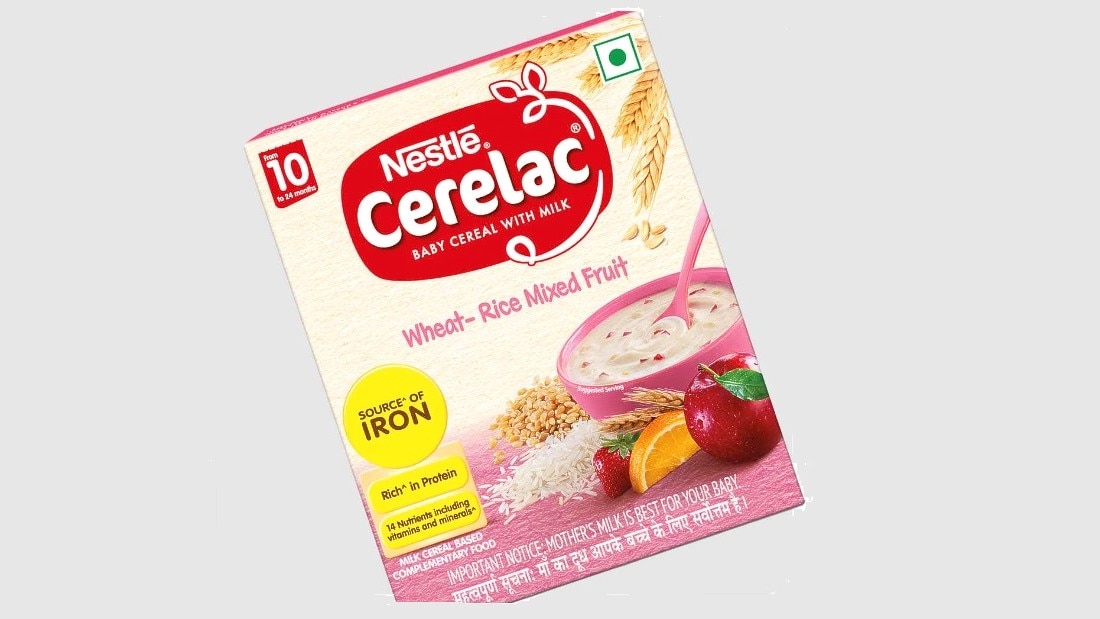
Recent revelations have uncovered that Nestle's Cerelac, a milk cereal-based complementary food for infants, contains excessive sugar, especially in developing countries such as India. This finding is contrary to the guidelines of the World Health Organization, which prohibit added sugar in baby food. The high sugar content in Cerelac raises concerns about compliance with established health standards.
A report by Swiss investigative organisation Public Eye shows that the consumer goods giant has different sugar content for Asian countries when compared to developed markets like US and Europe.
In India, for instance, Cerelac has been found to contain an average of nearly 3 grammes of added sugar per serving.
However, a Nestle India Ltd. spokesperson told NDTV Profit that the company has reduced the total amount of added sugars in its infant cereals portfolio by 30% over the past five years and it continues to "review" and "reformulate" products to reduce them further. "We believe in the nutritional quality of our products for early childhood and prioritise using high-quality ingredients," it said in an emailed statement.
After examining 150 products sold by the multinational in Asia, Africa and Latin America, Public Eye found that almost all the Cerelac infant cereals targeted at babies from six months of age contain added sugar of nearly 4 grammes per serving on average, equal to roughly a sugar cube.

As high as 7.3 grammes of added sugar per serving was detected in a product sold in the Philippines. Another powdered-milk brand, Nido, for young children from one–three years old examined also contains added sugar — almost 2 grammes per serving on average. A product sold in Panama was found to have 5.3 grammes of added sugar for every serving.
However, these products are sold without added sugar in Nestle's main European markets, including the UK, Germany and France.
Biscuit-flavoured cereals for babies aged six months and older contained 6 grammes of added sugar for every serving in Senegal and South Africa, the report found. The same product sold in Switzerland has none, it said.
In Brazil, where Cerelac is known as Mucilon, three-quarters of Cerelac baby cereals contain added sugar, on average 3 grammes per serving.
In its report, written in collaboration with the International Baby Food Action Network, Public Eye alleged that Nestle takes advantage of the weakness in existing regulations to continue selling such products. "There is a double standard here that can't be justified," Nigel Rollins, scientist at the WHO, was quoted as saying by Public Eye in its report.
Globally, Cerelac is the number one baby cereal brand, with sales exceeding $1 billion in 2022, according to Euromonitor International. The highest figures, according to the report, are in low- and middle-income countries, with 40% of sales just in Brazil and India.
Public Eye is petitioning Nestle to discontinue sugar usage in products designed for babies and toddlers under the age of three in every part of the world.

-
India's Troika Of Good Luck | Joining The Dots

A weaker Trump, a cooling AI trade and resilient earnings have put Indian markets back in favour. Rising inflation could spoil the party.
-
Talking Points This Week: Leadership Shock At Nvidia, Earnings Strength, And The Fog Over Hormuz
The Anthropic IPO pricing and first trading day, Nvidia's upcoming earnings, and any fresh signals from Iran will set the tone for the following week.
-
Signature Play: The Classic Cocktail Is Dead. Or Is It?
Classic cocktails are disappearing from India's cocktail menus. But they're still being ordered, taught to bartenders and borrowed from. So, who's really having the last drink?
-
A New Samvat Wishlist: Inclusive Prosperity And Human Development
India has strengthened its economic foundations through infrastructure, digital access and enterprise. Its next growth chapter must deepen productivity, create better livelihoods and widen participation in prosperity.
-
Love, Sex Aur Dhokha: The Audacious Plot To Spy On Jensen Huang
A Taipei dinner, a Singapore chip buyer and a suspected Chinese asset: inside the alleged spy operation that got close to NVIDIA's Jensen Huang.
-
Ten Things I Learnt This Samvat
Patience can be a trap. Cheap stocks can stay cheap. Leverage can wipe you out. What did Samvat 2082 teach us? Niraj Shah writes on 10 lessons from the year gone by.
-
Talking Points This Week: Tech Nerves, FII Buying, And A Faraway Banking Shock
The global markets are not shining this Diwali. The exception in the large markets is, India.
-
Midterm Rally Lasted A Day. The Hard Reality Of A Divided US May Last Two Years | Opinion
Between a contested AI boom, a debt ceiling that arrives in 2027 and a president with every incentive to act alone, the next two years may prove more volatile than the first day's rally suggests.
-
Blue Wave Will Derail the AI Trade but Won't Dismantle the AI Era | Unhedged Position
The Democrats' sweep of the US Congress will see politics collide with economic forces both over the long and short term.
-
It's Time To Take The GST Council's Bet On Trust Global
Payment records can prove India's services exports, and clear, proportionate rules can bring foreign digital sellers into the tax net.









