

'Misinformation': Amul Issues Clarification After Video Of Masti Dahi Failing Quality Tests Goes Viral
The video claimed the pouch version had potentially poorer hygiene or handling compared to the cup version.



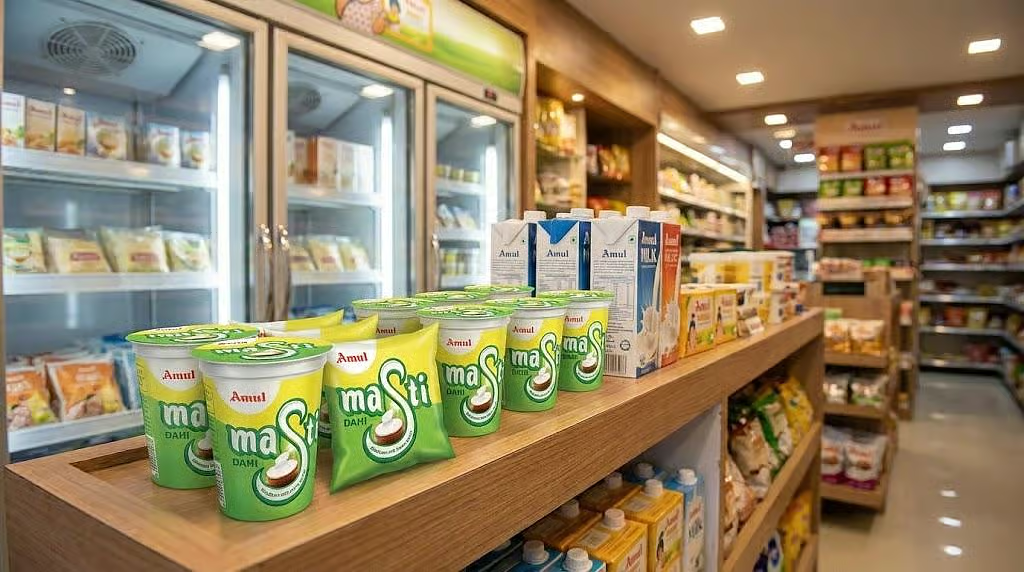
Indian dairy giant Amul has issued a rebuttal to a video posted by YouTube creator Trustified, who had claimed that the product Masti Dahi fails several quality tests.
In a social media post, Amul has branded the content as misinformation while pointing out that Masti Dahi, as any other products, meets all quality standards and follows FSSAI procedures.
This comes after the video from Trustified had gone viral, with the YouTuber's testing showing 4.95g of protein (vs. 4g claimed) and 3.51g of fat (vs. 3.1g claimed) per 100g in the pouch variant.
The video claimed the pouch version had potentially poorer hygiene or handling compared to the cup version.
"Dahi is a live product with healthy bacteria and should be handled carefully as per the instructions on the pack. We are not sure how the sample was drawn and handled before testing," Amul said in a statement.
"The Amul Masti Dahi pack meets all quality requirements mentioned under FSSAI as well as Amul internal quality standards," the company added.
Amul went on to point out that Masti Dahi is a product manufactured in ISO certified dairies and go through more than 50 'stringent' quality tests before being dispatched to the consumer. It also highlighted that the product passes all FSSAI procedures as well as Amul's own quality testing mechanism.
Crucially, Amul confirmed that both pouch and cup variants of Amul Masti Dahi go through the same processing and hygiene steps, adding that the difference in packaging caters to the different needs of the customer. This was a rebuttal to Trustified's initial claim.
Finally, Amul branded the video made by Trustified as misinformation and a tool to create public fear about the company's products.
"Such videos has been used to create misinformation and spread unnecessary fear and concern among consumers," Amul concluded.