How To Apply For Permanent Account Number (PAN)? Charges And Other Details Here
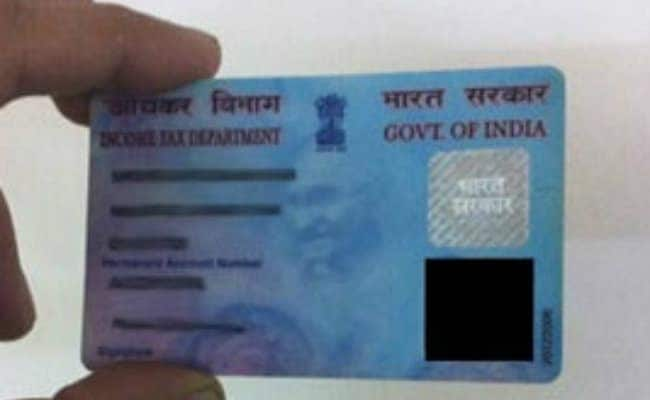
Permanent Account Number (PAN) card, which is issued by the Income Tax Department, enables the taxman to track all transactions of the person. PAN, the 10-digit alphanumeric number, helps the Income Tax Department maintain a record of all the financial transactions of an assessee. It is imperative to link the PAN card with all your bank accounts. Income tax returns (ITRs) cannot be filed without a PAN card. As the new financial year - 2018-19 - has just started, it might be significant for you to apply for and link all your financial transactions with your PAN card.
(Also Read: New Income Tax Return (ITR) Forms Seek More Salary Details - 10 Points)
Here are five key things that you must know about PAN card:
1. PAN was introduced to facilitate linking of various documents. These include payment of taxes, assessment, tax demand, tax arrears etc. relating to an assessee. The aim was to facilitate easy retrieval of information and to facilitate matching of information relating to investment, raising of loans and other business activities of taxpayers collected through various sources - internal as well as external - for detecting and combating tax evasion and widening of tax base, according to the I-T department.
(Also Read: Standard Deduction Of Rs. 40,000 Available For Pensioners. Details Here)
2. It is mandatory to quote PAN on return of income and all correspondence with any income tax authority. From January 1, 2005 it has become mandatory to quote PAN on challans for any payments due to Income Tax Department, according to its website - incometaxindia.gov.in.
3. PAN or Permanent Account Number is a ten-digit alphanumeric number. A typical PAN looks like this: AFZPK7190K.
4. By using the Online PAN Verification facility on the Income Tax Department's website, an individual can know/verify his or her PAN. This facility is referred to as "PAN Verification" or "Know Your PAN".
5. The Income Tax Department has an electronic portal for lodging PAN grievances through 'Aayakar Sampark Kendra' (Income Tax Communication Centre).
(Also Read: SBI Income Tax Savings Scheme: Interest Rates, Tax Benefits, And Other Details)
How to apply for a PAN card:
Applications for fresh allotment of PAN can be made online, according to the Income Tax Department. Requests for changes or correction in PAN data or request for reprint of PAN card (for an existing PAN) may also be made online.
Online application can be made either through the portal of NSDL or portal of UTITSL, mentioned the I-T department on its website. UTIITSL or UTI Infrastructure Technology And Services Limited is a government-owned company that provides technology and outsourcing services to the financial and government sectors of India. NSDL or National Securities Depository Limited is the largest depository in the country. (Also Read: Income Tax Rule Changes For Senior Citizens - How Much Extra Benefit They Get)
PAN card application charges
The charge for applying for PAN is Rs. 93 (excluding Goods and Services tax) for an Indian communication address and Rs 864 (excluding Goods and Services tax) for a foreign communication address, according to the Income Tax Department's website. Payment of application fee can be made through credit/debit card, demand draft or net banking.
Once the application and payment is accepted, the applicant is required to send supporting documents through courier/post to NSDL/UTITSL. Only after the receipt of the documents will the PAN application be processed by NSDL/UTITSL.
(Also Read: Income Tax Return Filings Surge 26% In 2017-18, Rs.1.49 Lakh Crore Refunds Issued)
Individuals can submit PAN applications at the PAN application centres as well.

-
Unhedged Position: Can India See An Indonesia-Style Time Correction?

The Nifty is trading below levels it first clocked in 2024. Is there, then, as I have suggested in the headline, potential that the current time correction drags on painfully for the next three-five, even ten years?
-
Navigating Friction And Energy Realities: An Analysis Of Marco Rubio's October Visit To India
Occurring at a critical juncture marked by stalled trade negotiations and escalating geopolitical pressures over global energy supplies, the visit offers a profound window into modern US-India relations.
-
India Exports Capital. Why Not Export Trusteeship?
The big question, then, is whether India can build an institution that global borrowers, investors, banks, and lawyers can trust, even without an Indian connection.
-
France's Economy & Politics Are In Crisis | The Reason Why
Let's look at how the French economy and politics evolved under Nicolas Sarkozy, Franois Hollande and Emmanuel Macron.
-
You May Inherit The Business. You Must Earn Its Credibility.
Succession tests the founder's ability to share authority as much as it tests the next generation's readiness to assume it.
-
Signing Deals Is One Thing; Making Them Work Is Another | The Week In Whys
Sometimes, things don't turn out as planned. Indian companies have lost some bids to rivals, some projects won't produce until 2030.
-
FOMC Wall, PERM Suspension, Hospital Stocks | Talking Points This Week
A PERM suspension would directly affect green-card sponsorship rather than H-1B visas, so the near-term earnings impact could remain relatively limited. The key question is whether this marks a new phase in US scrutiny of Indian IT.
-
Everything, Everywhere, All At Once: Dalal Street's Week To Forget | Joining The Dots
Visa curbs, a Starlink spat and cancer drug caps: what connects this week's shocks for Indian markets
-
India Is Going Abroad For Critical Minerals. But It May Take Years To Pay Off | The Reason Why
Although India's steps are in the right direction, they remain modest compared with India's growing dependence.
-
When Everyone Has AI, What Gives You An Edge?
India's young workforce is entering an uncertain world of work where powerful AI tools are becoming widely accessible. The advantage will belong to those who combine deep expertise with digital fluency, and the distinctly human capabilities that technology cannot manufacture.









