Hyundai India Accounts For Nearly A Fourth Of Carmaker’s Global Sales

Nearly one in four Hyundai cars are sold in India now. A local IPO isn't a pipedream then.
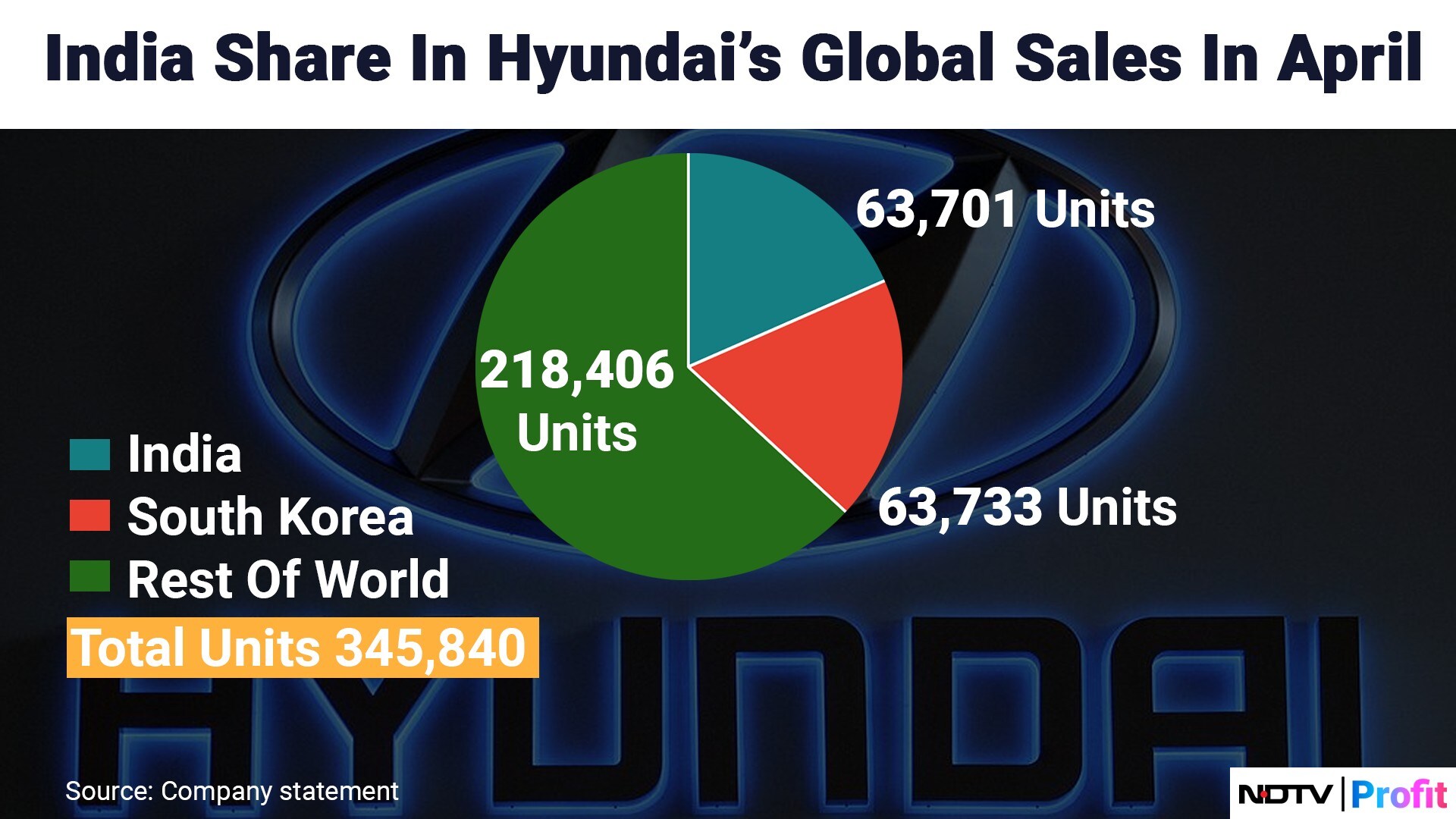
Global sales of Hyundai Motor Co. Ltd. rose 3.3% over the previous year to 345,840 units in April 2024, according to a company statement Thursday. But what's interesting is that India volumes match up to those in the home market of South Korea.
In South Korea, the carmaker sold 63,733 units—a decline of 4.4% year-on-year. In India, sales volume rose 10% year-on-year to 63,701 units. That includes 50,201 cars sold locally and 13,500 cars made for exports.
“In April 2024, Hyundai Motor India achieved a fourth consecutive month of 50,000-plus units in domestic sales,” Tarun Garg, chief operating officer of India operations, said in a statement on May 1. “Driven by models like the Creta, Venue and Exter, SUVs continued to be a growth driver contributing 67% of domestic sales.”
Hyundai Motor acknowledged the contribution.
“With the brand witnessing solid sales momentum in North and South America, and India, sales outside South Korea increased by 5.2% in April to 282,107 units,” according to the statement released on May 2. “In South Korea, Hyundai Motor sold 63,733 units in April, a decrease of 4.4% compared with the same month last year.”
The sales data assumes significance, especially amid media reports that Hyundai Motor is planning an initial public offering of its India unit some time later this year.
According to Bloomberg, Hyundai Motor has hired Citigroup Inc. and JPMorgan Chase & Co. for an India IPO to raise about $2.5 billion. That would rank among the country's biggest listings ever. The fundraising would value Hyundai Motor India at up to $30 billion, which is more than half of the market capitalisation of the parent firm in South Korea but still less than that of Maruti Suzuki India Ltd. and Tata Motors Ltd. at more than $40 billion each.
A Hyundai India IPO would boost the Creta maker's expansion plans in a country where it has operated for more than 25 years. India, itself, has emerged as the third largest auto market in the world, overtaking Japan. A listing would also reduce the India unit's dependence on the parent firm for funds.
“India will become the ground to raise money for local projects. Hyundai understands the market dynamics,” Reuters quoted S&P Global Mobility's Gaurav Vangaal as saying.
An influx of primary capital will also allow Hyundai India to build its EV infrastructure here.
Hyundai India plans to launch its first mass-market electric car early next year. By 2030, five more such models are planned, COO Garg said on Wednesday. It already assembles the Ioniq 5 and Kona electric cars locally—as many as 1,800 of these were sold last year.
Additionally, Hyundai Motor Co. and sister company Kia Corp. have partnered with Exide Energy Solutions Ltd.—a unit of India's largest battery maker Exide Industries Ltd.—for EV battery localisation.
In April, Hyundai Motor sold 19,000 electric cars globally. It now plans to step up its EV drive by launching models tailored to regional geographies.

-
'Never Seen This Level Of Negativity': Sandeep Tandon Says The Next Rally May Be Closer Than You Think

Veteran investor Sandeep Tandon says foreign selling is easing, large-caps are due a comeback and mid-caps are crowded, while he turns positive on gold, power and pharma this Diwali.
-
Indians Stay With Family, Not In Hotels | The Reason Why
India still lacks enough clean, reliable and affordable hotels for budget-conscious travellers.
-
The Economic Imperative: Analysing The Material Driving Force Behind India-Canada Strategic Reset
This economic complementarity is further reinforced by deep institutional investment ties and talent mobility, which form the bedrock of the bilateral framework.
-
Medicine Pricing: Where Must Profit Stop?
India must confront excessive margins, hidden incentives and regulatory gaps that threaten the integrity of medicine.
-
Why Amazon And Flipkart Are Struggling To Beat Meesho In India's Smaller Cities
With 274 million users and lowest-cost logistics, Meesho is defending its value commerce crown against giants like Amazon and Flipkart.
-
High US Salaries, No Green Card Certainty: The Financial Calculation Facing Indian H-1B Families
The suspension of PERM processing at eight technology employers does not cancel existing H-1B visas. What it does is force a question many Indian families have been avoiding: is the US salary worth tying your career and family plans to one employer?
-
Swiggy vs Eternal: Food Delivery's Two Rivals Are No Longer In The Same Race
Eternal is building a private AI assistant, dark.ai. Swiggy is still working out how to make Instamart pay, with an operating loss of Rs 895 crore in the July-September quarter while Blinkit stayed profitable.
-
Where You Live Shapes How You Get To Work | The Reason Why
Two-wheelers are the most popular way to get to work in India, accounting for nearly 43% of workplace commutes.
-
Unhedged Position: Can India See An Indonesia-Style Time Correction?
The Nifty is trading below levels it first clocked in 2024. Is there, then, as I have suggested in the headline, potential that the current time correction drags on painfully for the next three-five, even ten years?
-
Navigating Friction And Energy Realities: An Analysis Of Marco Rubio's October Visit To India
Occurring at a critical juncture marked by stalled trade negotiations and escalating geopolitical pressures over global energy supplies, the visit offers a profound window into modern US-India relations.










