At -23.9%, GDP Contracts At Its Steepest Pace On Record
- Monday's data marks the likely onset of India's deepest recession on record, which is widely expected to run through the second half of the fiscal year, as the rapid spread of the pandemic continues to weigh on demand, hindering a pickup in economic activity. Typically, recession is defined as two consecutive quarters of decreasing GDP.
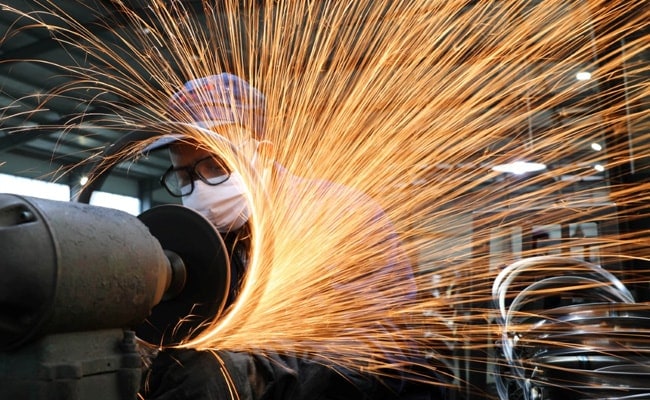
- Financial services - the biggest component of the country's services sector, shrank 5.3 per cent compared to the corresponding period a year ago. Manufacturing and construction shrank 39.3 per cent and 50.3 per cent respectively. Agriculture bucked the trend, with an expansion of 3.4 per cent.
- Though the coronavirus-related restrictions have been gradually lifted, there has been an impact on the economic activities as well as on the data collection mechanisms, the government's statistics office said. Challenges related to other underlying macroeconomic indicators such as industrial production and consumer inflation will also have implications on these estimates, it said, mentioning likely revisions "in due course".
- The data comes as the government is strategically removing restrictions imposed in March to curb COVID-19 infections, which have caused thousands of job losses and forced the majority of workforce to stay indoors, leading to a big blow to an already-slowing economy.
- Chief Economic Adviser Krishnamurthy Subramanian said, "India was in a lockdown all through April to June quarter with majority of economic activities being restricted. So this trend is along expected lines... Core sector output is clearly showing a V-shaped recovery."
- COVID-19 is spreading faster in India than anywhere else in the world, as daily tallies have exceeded those of the US and Brazil for almost two weeks. India currently has more than 3.54 million cases, and 63,498 deaths.
- Economists say the rapid increase in COVID-19 cases amid stretched public finances and soaring inflation means a recovery may not take place soon. Some say the economy could see a contraction of nearly 10 per cent in the year through March 2021.
- In May, PM Narendra Modi announced a stimulus package equivalent to 10 per cent of GDP - including credit guarantees on bank loans and free food grains to the poor - but consumer demand and manufacturing have yet to recover. Many economists have said that much of that support was already budgeted for by the government and very little included new spending.
- Just before the pandemic, the government was aiming at transforming the economy, from an estimated $2.8 trillion, to $5 trillion by 2024, despite slowing growth and low demand.
- The Reserve Bank of India has reduced the key interest rates by 115 basis points (1.15 percentage point) since March to revive the economy, but is watchful of worsening inflationary pressures. It has already shifted gears to focus on economic health for the time being, instead of inflation.

-
Unhedged Position: Can India See An Indonesia-Style Time Correction?

The Nifty is trading below levels it first clocked in 2024. Is there, then, as I have suggested in the headline, potential that the current time correction drags on painfully for the next three-five, even ten years?
-
Navigating Friction And Energy Realities: An Analysis Of Marco Rubio's October Visit To India
Occurring at a critical juncture marked by stalled trade negotiations and escalating geopolitical pressures over global energy supplies, the visit offers a profound window into modern US-India relations.
-
India Exports Capital. Why Not Export Trusteeship?
The big question, then, is whether India can build an institution that global borrowers, investors, banks, and lawyers can trust, even without an Indian connection.
-
France's Economy & Politics Are In Crisis | The Reason Why
Let's look at how the French economy and politics evolved under Nicolas Sarkozy, Franois Hollande and Emmanuel Macron.
-
You May Inherit The Business. You Must Earn Its Credibility.
Succession tests the founder's ability to share authority as much as it tests the next generation's readiness to assume it.
-
Signing Deals Is One Thing; Making Them Work Is Another | The Week In Whys
Sometimes, things don't turn out as planned. Indian companies have lost some bids to rivals, some projects won't produce until 2030.
-
FOMC Wall, PERM Suspension, Hospital Stocks | Talking Points This Week
A PERM suspension would directly affect green-card sponsorship rather than H-1B visas, so the near-term earnings impact could remain relatively limited. The key question is whether this marks a new phase in US scrutiny of Indian IT.
-
Everything, Everywhere, All At Once: Dalal Street's Week To Forget | Joining The Dots
Visa curbs, a Starlink spat and cancer drug caps: what connects this week's shocks for Indian markets
-
India Is Going Abroad For Critical Minerals. But It May Take Years To Pay Off | The Reason Why
Although India's steps are in the right direction, they remain modest compared with India's growing dependence.
-
When Everyone Has AI, What Gives You An Edge?
India's young workforce is entering an uncertain world of work where powerful AI tools are becoming widely accessible. The advantage will belong to those who combine deep expertise with digital fluency, and the distinctly human capabilities that technology cannot manufacture.









