

4,000,000% Returns: Berkshire Hathaway's Share Run That Defined Warren Buffett
As Buffett retires, the chart tells the truth better than any tribute: This wasn’t about timing markets. It was about building a machine that made time work harder than anyone else ever has.



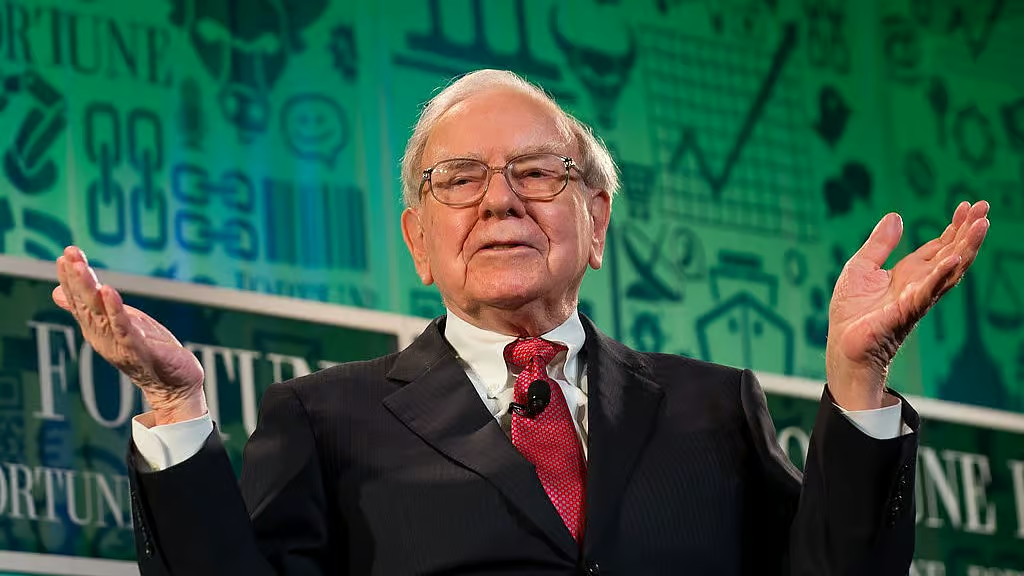
Today marks Warren Buffett's final day as CEO of Berkshire Hathaway — and the most fitting way to tell his story is through the stock journey he has charted, taking a $19 share to a whopping $7,55,400-level.
When Buffett took control of the American company in 1965, it was a failing textile mill, trading at about $19 a share. For years after that, the stock barely moved. The first decade of Buffett's tenure could almost be defined as boring, with restructuring and capital discipline.
The real inflection came in the late 1970s and 1980s, when Buffett pivoted decisively away from textiles and toward insurance — buying National Indemnity and later GEICO.
The Trajectory
The 1990s were when the curve began to bend. As Berkshire accumulated stakes in Coca-Cola, American Express and other cash-rich businesses, the stock started compounding more visibly.
Even then, it wasn’t smooth. Berkshire lagged badly during the dotcom boom, a period critics said proved Buffett was 'out of touch.'
The real acceleration came post-2008. While markets reeled during the global financial crisis, Berkshire deployed capital aggressively, striking deals with Goldman Sachs, General Electric and others.
From the 2010s onward, the stock’s trajectory steepened dramatically as Berkshire evolved into a diversified holding company — spanning insurance, railroads, energy, manufacturing and equities.
By the 2020s, the chart no longer looked linear, but curved starkly upward. Apple became Berkshire’s most valuable holding, and buybacks added fuel.
The 3,950,000% Surge
Today, Berkshire’s Class A shares trade over $750,000, representing a gain of roughly 3,950,000% since 1965. There were no shortcuts and no parabolic bursts — just long stretches of quiet followed by relentless accumulation.
As Buffett retires, the chart tells the truth better than any tribute: This wasn’t about timing markets. It was about building a machine that made time work harder than anyone else ever has.
The line may stop moving under Buffett’s watch today, but the lesson embedded in it won’t.