

Tesla Sales Outlook Darkens Despite Elon Musk's Self-Driving Euphoria
On Friday, Tesla is expected to report that it delivered around 440,900 vehicles in the fourth quarter, down 11% from a year earlier.



Tesla Inc. ended last year on a roll, with investors increasingly buying into Elon Musk’s ebullience about autonomous vehicles. Winning over actual car buyers was another story.
Shares in the world’s most valuable auto company soared in the second half, largely on the basis of its chief executive officer touting advances in artificial intelligence and robotics. But the progress Musk trumpeted didn’t translate to success in showrooms — the company likely sold fewer vehicles in the last six months than a year earlier, despite record deliveries in the third quarter.
On Friday, Tesla is expected to report that it delivered around 440,900 vehicles in the fourth quarter, down 11% from a year earlier, according to data compiled by Bloomberg. Tesla took the unusual step this week of publishing its own average of analyst estimates that was even more pessimistic, calling for a 15% decline.
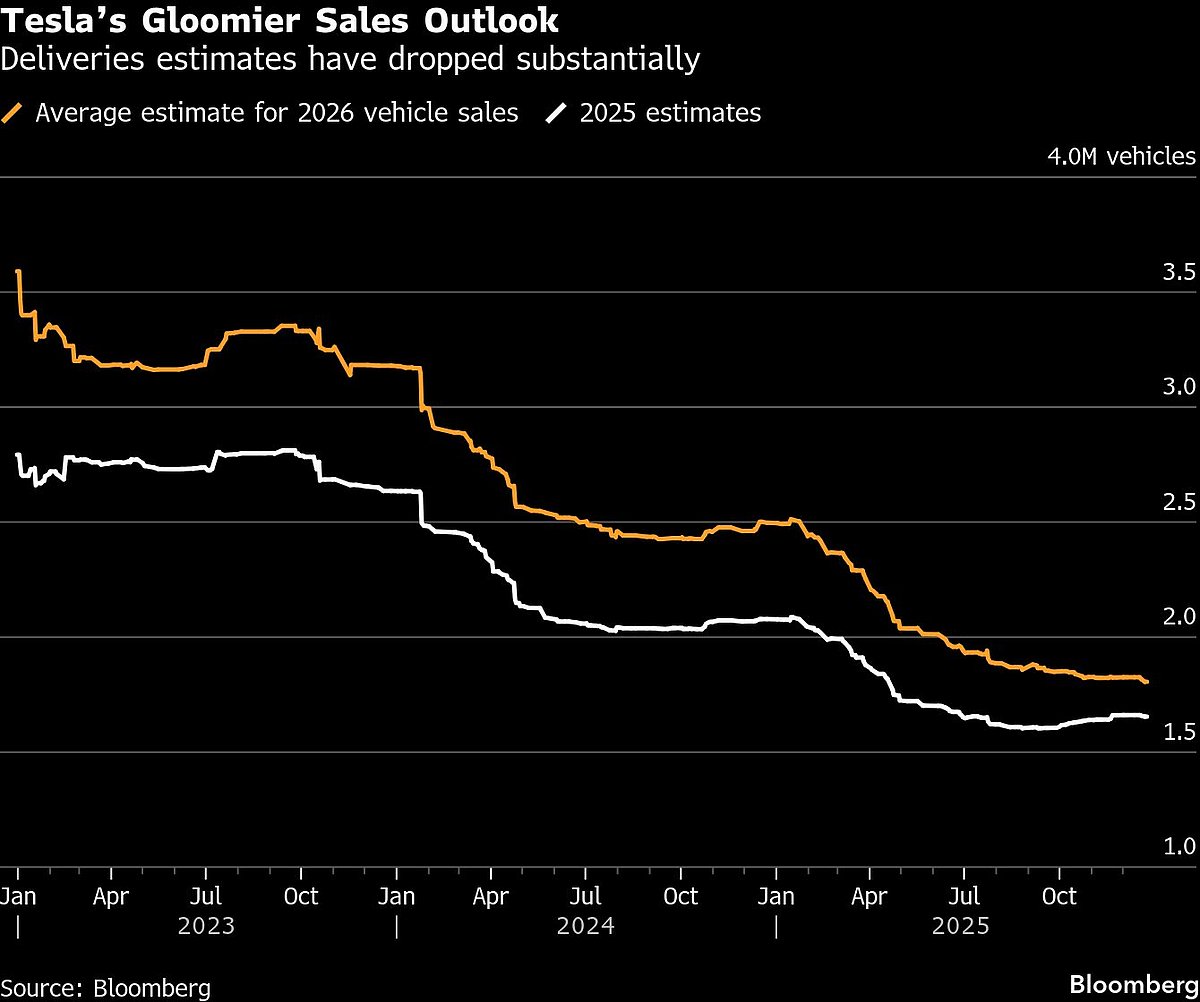
Wall Street has grown similarly gloomy about the outlook for 2026. This time two years ago, analysts were predicting Tesla would deliver more than 3 million vehicles. That average estimate for deliveries this year has plunged to roughly 1.8 million.
“Tesla investors are focused on how the company might look five, 10, 15 years down the road, and really discounting what they see in the near term,” Garrett Nelson, an equity analyst at CFRA Research, said by phone. “The question is, can they maintain that, especially when we think headwinds are going to become more apparent in the financials?”
Topsy-Turvy
Even by the standards of Musk and Tesla — two names synonymous with turbulence — 2025 was a tumultuous year.
The carmaker’s vehicle sales got off to a dismal start, partly due to the company retooling production lines at each of its auto plants for the redesigned Model Y, its most popular vehicle. Another major factor was the intense backlash against its CEO’s work for US President Donald Trump.
By early April, when Musk was publicly feuding with members of the administration over tariff policy, Tesla’s stock had plummeted 45% for the year.
Musk spurred the recovery by stepping back from government and returning to work on a longtime goal: starting a ride-hailing business with cars he’s said will eventually be autonomous.
In June, Tesla launched an invite-only Robotaxi service in Austin, with safety operators on board to supervise each of the Model Ys ferrying Musk fans around the Texas capital. While the vehicles violated traffic laws on day one — drawing the attention of a federal regulator that’s opened multiple investigations into the company’s driving systems — investors have shrugged off the safety concerns.
Tesla’s board then proposed a new compensation package for Musk in September, offering a payout potentially worth $1 trillion depending on milestones including delivering millions of robotaxis. Soon after, the comeback was complete — Tesla shares were trading higher for the year.
When the stock closed at a new all-time high on Dec. 16, the company had added more than $915 billion in market capitalization in just over eight months.
Needing Convincing
But while Tesla’s robotaxi prospects have captivated investors, car buyers have been relatively circumspect.
Musk himself has acknowledged challenges persuading consumers to purchase what Tesla markets as Full Self-Driving, or FSD, a suite of features that still require human supervision. Allegations that Tesla is misleading Californians by exaggerating the automated-driving capabilities of its vehicles could lead to the state suspending the company’s sales license for 30 days early this year.
Tesla’s attempt to distinguish itself in China’s crowded electric vehicle market with driver-assistance functions also isn’t working out, with companies including BYD Co. and Xiaomi Corp. offering similar systems as standard features.
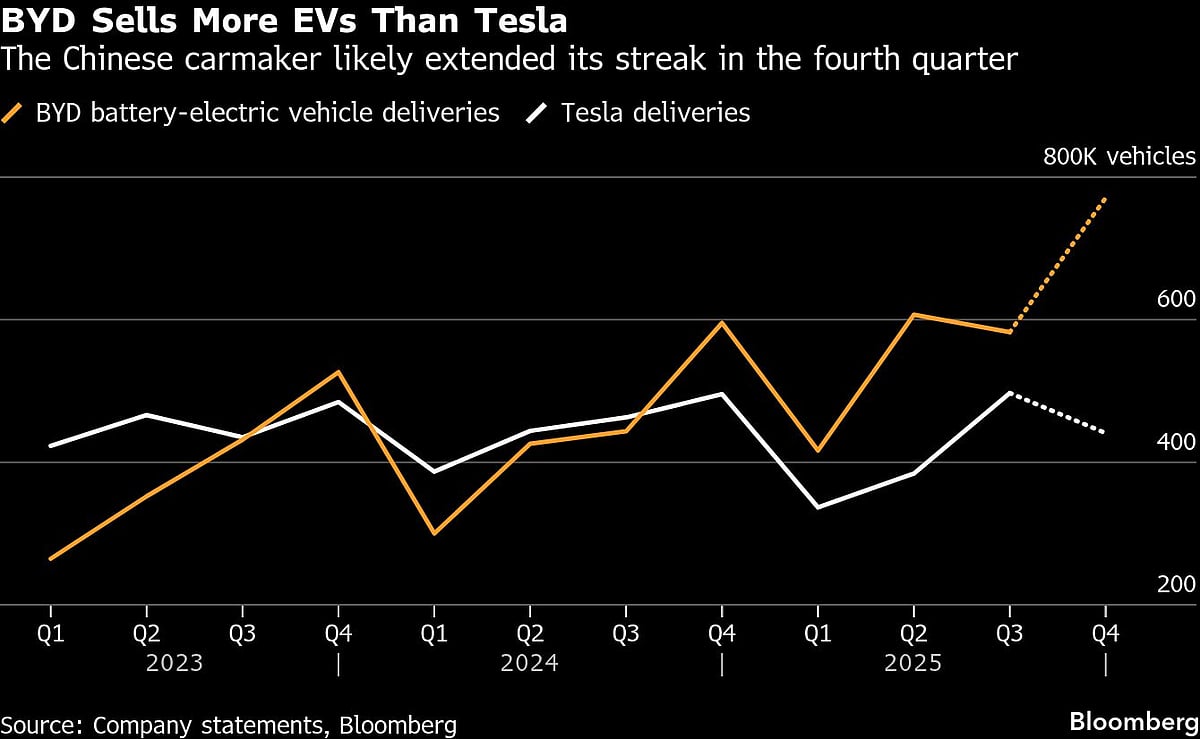
Due largely to BYD’s far higher sales in China and surge of momentum in Europe — where Tesla has been unable to obtain regulatory approval for FSD — analysts expect the Shenzhen-based carmaker to have sold more battery-electric vehicles worldwide for a fifth quarter in a row.
Moving Forward
After a widely anticipated annual sales decline — its second in a row — Tesla has more hurdles to contend with in 2026. The US has ceased offering federal tax credits for EV purchases and leases, which Musk has warned could lead to “a few rough quarters.”
Some see a silver lining in the withdrawal of US policy support, which has led major manufacturers to pull back from EV investments. Ford Motor Co. said last month it expects to record about $19.5 billion in charges tied to abandoning EV and battery projects that were destined to lose money.
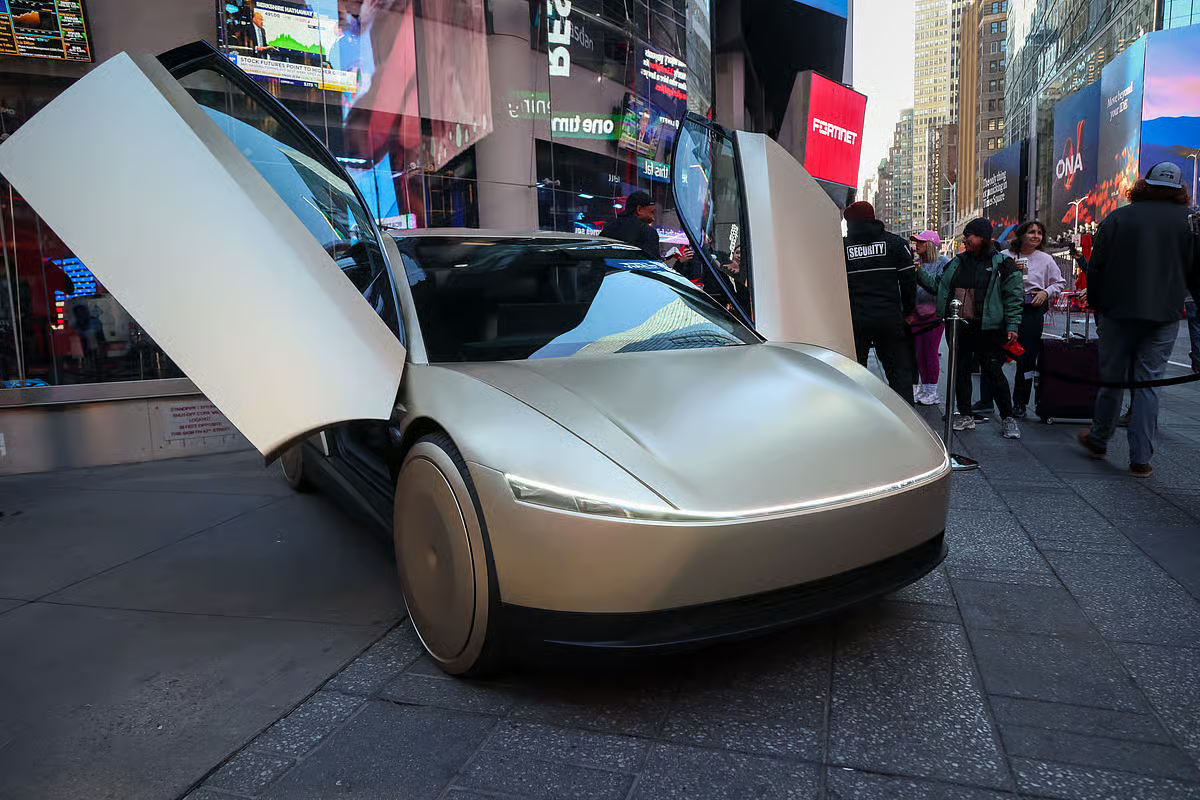
Musk ended the year by building anticipation for Cybercab, a two-seat compact car with butterfly doors. While the prototype he first unveiled in late 2024 lacked a steering wheel or pedals, Tesla’s board chair Robyn Denholm told Bloomberg News in October that the company will sell the car with those components if required by regulators.
“Investors have fully bought into his autonomous vision, which comes at a good time, as Tesla’s EV business will likely be flat to up 5 percent next year,” said Gene Munster, managing partner at Deepwater Asset Management. “At this point, Elon only needs the car business to stabilize over the next year to satisfy investors.”