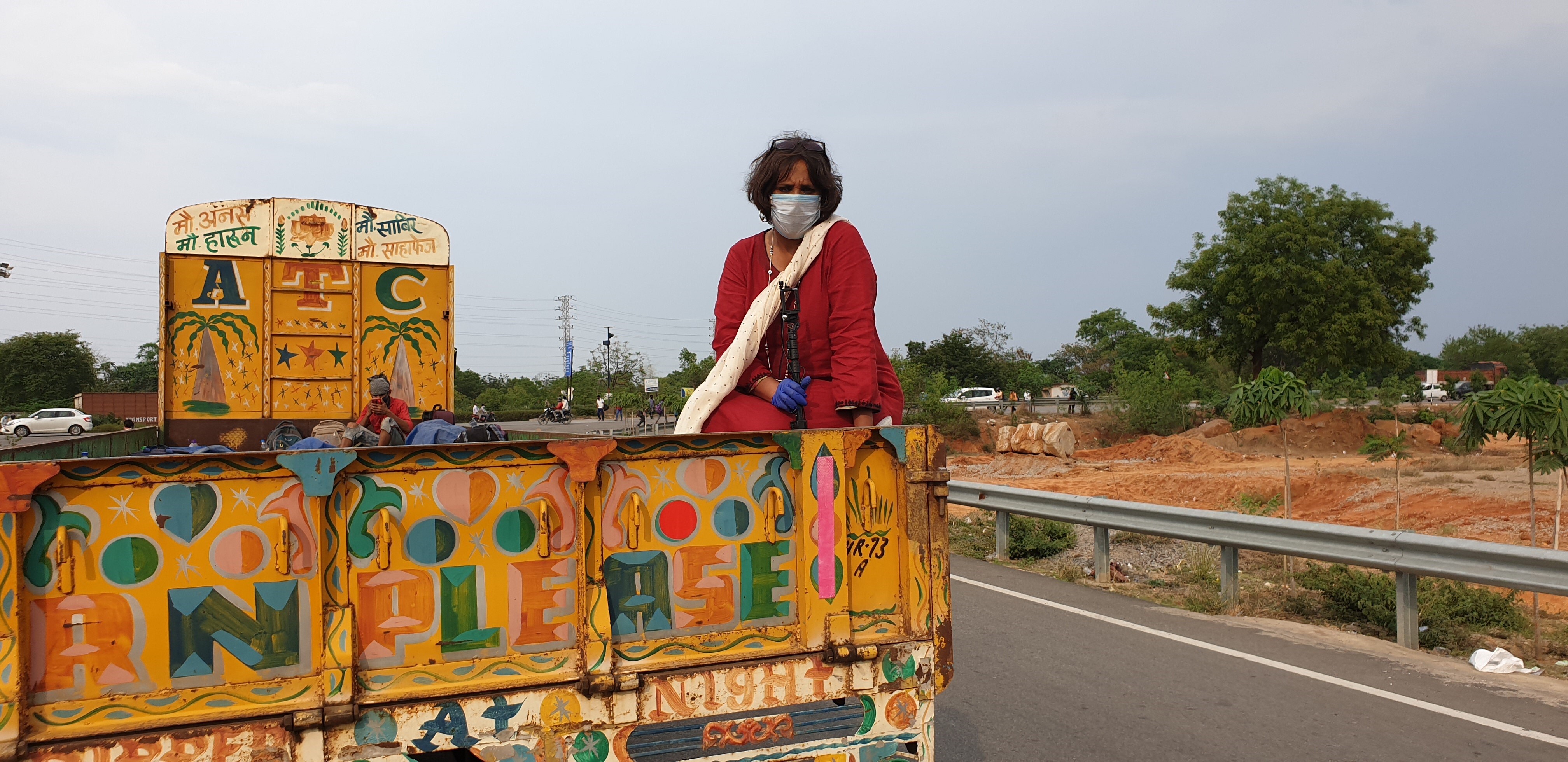
When Barkha Dutt hit the road for 120 days, covering 24,000 kilometres across 13 states and union territories to report the exodus of millions of migrant workers who were fleeing cities on foot—after a sudden and cruel lockdown announced on March 24 left them jobless and homeless—she met reporters and photographers covering the humanitarian crisis. But until day 50, she says, she saw no one from any television channel.

Dutt's relentless stories from the road, with her driver Vinod, producer Prashanti and cameraperson Madan, made even her critics sit up and take note. “The experience gave me hope that you did not need giant capital or resources to claim an issue as your own if you had enough passion and consistency.” During those months, Dutt's regular despatches on Mojo, the YouTube channel run by her multimedia content and events company Barkha Dutt Media Pvt. Ltd., were all over the Twitter feed of her 7.2 million followers.
“We have seen a generation of journalists who used their individual reputations to benefit themselves. Now we are using our reputation to build whatever institutions we can,” says Josy Joseph who quit a cushy job as National Security Editor at The Hindu newspaper to start an “independent, and academically-rigorous” journalism startup Confluence Media, which last year raised money from high net worth individuals such as Accel founder Jim Swartz.
For a while now independent media startups have together provided coverage of real issues and a democracy under threat. You're already familiar with Scroll, Wire, Quint, Newslaundry, Alt News, The News Minute, Gorakhpur Times, Live Law, People's Archive of Rural India (PARI), and India Spend, all founded this past decade, and earlier entrants like Khabar Lahariya, Gaon Connection, Media Nama, News Click, and Youth Ki Awaaz. Now there's another generation of media startups doing their bit to keep journalism alive.
Can their efforts reach and impact brains being rewired by the relentless, addictive drip of social media? As Filipino journalist and Rappler co-founder Maria Ressa puts it in the latest issue of Nieman Reports, “Today, an atom bomb has gone off in our information system, and we pretend it didn't happen. We have to come together globally because in each of our countries, the vertical system of information is gone…We need to find a global solution.”
Media startups across the world are brainstorming guerrilla tactics to fight authoritarian regimes whose popularity is driven by social media and ways to do journalism differently from the flailing mainstream organisations at which their founders likely cut their teeth.
Indian journalism is reinventing as well, in the midst of a credibility- and job-loss crisis.
The Reporters' Collective, a newly-launched collaborative journalism startup, recently won The Asian College of Journalism's award for investigative journalism. One of its founders Nitin Sethi is also the media lead for a just-announced fellowship program for independent journalists at the National Foundation for India. The fellowship “will respond to the current crisis in journalism, strengthen credible reportage and enable independent journalists,” Sethi tweeted.
#Thread: Some good news.
(Please stay with me till the end.)
1. We are setting up a new Fellowship Program for Independent Journalists.
To create and establish it, I have joined as the Media Lead at the National Foundation for India @NFI_India.In the eight months it's been around, The Reporters' Collective has partnered with many mainstream regional news outlets as well as like-minded independent media outfits such as multi-lingual audio story platform Suno India and Article 14 (this one is close to home as the bio below this column suggests) to ensure its investigations reach maximum readers.
“If you are fed up with the mainstream media circus, please take out a few minutes for ChalChitra Abhiyaan,” Nakul Singh Sawhney tweeted about his three-year-old western Uttar Pradesh startup, which, among other things, trains locals to tell their own stories on video. You can see the film and media collective's work on Telegram, Youtube, and Facebook.
Anubha Bhonsle, former executive editor at CNN-IBN, who says she often jokes that we are more careful about getting our coffee right than our news, has a simple premise for her startup NewsWorthy: News that's worthy of your time and attention.
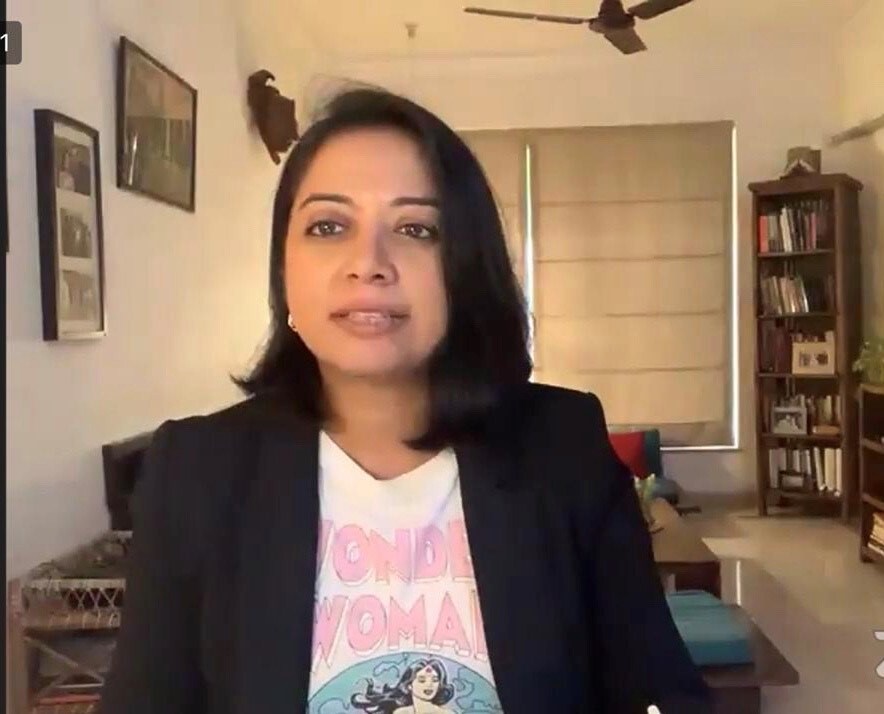
Faye D'Souza throws a black jacket over her Wonder Woman t-shirt, settles down in her living room in front of a borrowed ring light, and speaks into her phone, telling you stories you won't find on television. Yes, that's her dog Phoebe you see in the frame, a rescue who was found abandoned on the streets last year. “There's a market for even-toned reportage/conversation. The focus for me is on just delivering information—not doing outrage, not doing activism,” says D'Souza, once the popular executive editor of Mirror Now. “I've never been more grateful and more convinced about my decision to leave TV media last year.” When she did discuss Rhea Chakraborty, who has been in the eye of a frenzied media trial, D'Souza stuck to examining the legality of the case.
When D'Souza quit in October, she had 38,000 Instagram followers. By July, thanks mainly to her relentless plain vanilla text posts titled News That Should Be Headlines that targeted the youth, she had gathered 500,000 followers. These past months her Beatroot News, a brand of Free Media Interactive Pvt. Ltd., has been run by a handful of people, on their phones and laptops. Look out for an exciting announcement from her next week.
From the hyperlocal Rocket Post—a WhatsApp broadcast group in Uttar Pradesh's Pilibhit district where 16,000 thousand subscribers pay Rs 100 a year to avoid fake news—to three-year-old The Print, equal parts golden child and terrible toddler, that has brought back traditional beat reporting (editor Shekhar Gupta, an old-style journalist remembers and is fond of recounting every anecdote from his more than 40-year reporting career), journalism is seeing a Renaissance.
Talking of the Renaissance, editors at independent news organisation Media Vigil, which focuses on “un-reported, miss-reported and under-reported stories” and founded by veteran Hindi journalist Pankaj Srivastava, believe this period of history—a time of dramatic social change—is so relevant to the turmoil in today's India, they have two video shows based on it. “We cater to the poor Muslim, the adivasi, and the radicalised Hindu. We are not preaching to the already converted,” says Mayank Saxena, an editor at Media Vigil and a former Bollywood script writer.
We use very colloquial language, village muhavaras (idioms). I want 10 lakh people to give us Rs 10 a month.Mayank Saxena, Media Vigilहमारा विशेष कार्यक्रम Facebook Live पर..
दिया जल रहा है..
हवा चल रही है.....दोपहर 12.30 से आज...
अधिक जानकारी के लिए वीडियो देखें..@nsaibalaji @Shehla_Rashid #UmarKhalid pic.twitter.com/0tK4II9feqRocket Post's Shivendra Gaur has a similar business plan. “For an independent journalist, there's nothing better than when your revenue comes directly from your subscribers and you're accountable only to them,” he says. These days Gaur is also the editor of Daily Hunt's Hindi news business but he has plans to scale up to 1 lakh Rocket Post subscribers and replicate his idea in other cities.
There are dozens of promising newly-born startups this columnist hasn't been able to speak to. Many, like East Mojo, which has a network of mobile-journalism trained citizen-reporters across the north-eastern states, have sharply-defined ideas of their target audience. The three students who in 2017 set up digital magazine The Bastion and continued to run it after they graduated have discovered how difficult it is to get readers to care about development issues.
“To me, this is the vital question,” says Sethi. “Does Indian philanthropy have the guts to back journalism not as a ‘model' alone but as an essential service in a democracy? If it doesn't then we shall see small brave experiments mushroom and fail over time.”
“Creating your own platform and making it sustainable may be possible but is your journalism going to provide a comfortable lifestyle for a handful of journalists or make an impact on society?” asks Joseph. The lesson he learned from the Malayalam news startup he launched with his wife Priya Solomon in 2013 was simple: “if you can't scale up, don't get into this business”.
The author of the 2016 book A Feast of Vultures: The Hidden Business of Democracy In India is experimenting with many formats including film, television, books, documentaries, podcasts, international collaborations on news investigations, and any other medium that will inspire social change. “We are a platform-agnostic media startup, we'll go anywhere we can reach millions,” he says. Joseph is working on a non-fiction book about the birth of Indian democracy with author Adrian Levy. “There's no better time to celebrate democracy and the birth of India and to fight fake news. I'm hoping this book will do what Freedom at Midnight did to our generation,” he tells me.
Dutt's business model includes revenues from We The Women, an event property she created a few years ago; partnerships; monetisation of social media platforms such as YouTube; subscription; advertisements; and outsourced production jobs. D'Souza says among other things, she's working on a membership programme that will offer closed conversations and access to more in-depth reporting. Bhonsle, meanwhile, is channeling the money she earns elsewhere into her startup. The two fixed deposits she set up for this purpose two years ago are still intact.
It can get lonely for many entrepreneurs who are used to the support of big media organisations, but they're getting the chance to disseminate news exactly the way they want.“Right now there's a generation of under-informed young voters and nobody is talking to them,” says D'Souza. Her Instagram audience loved the t-shirts she wore during the lockdown because she was too lazy to get dressed before her show. She's found her sweet spot.
If all the others do too, maybe we will succeed in rewiring some synapses.
Priya Ramani is a Bengaluru-based journalist and is on the editorial board of Article-14.com.
The views expressed here are those of the author and do not necessarily represent the views of BloombergQuint or its editorial team.
Essential Business Intelligence, Sharp Market Insights, Practical Personal Finance Advice, Daily Fuel, Gold and Silver Prices and Latest Stories — On NDTV Profit.