

The 10-Minute Delivery Myth, And What Blinkit’s New Move Changes For You
More than a service promise, the 10-minute tag was a branding exercise that helped Blinkit and rivals carve out a distinct identity in the crowded quick-commerce space.



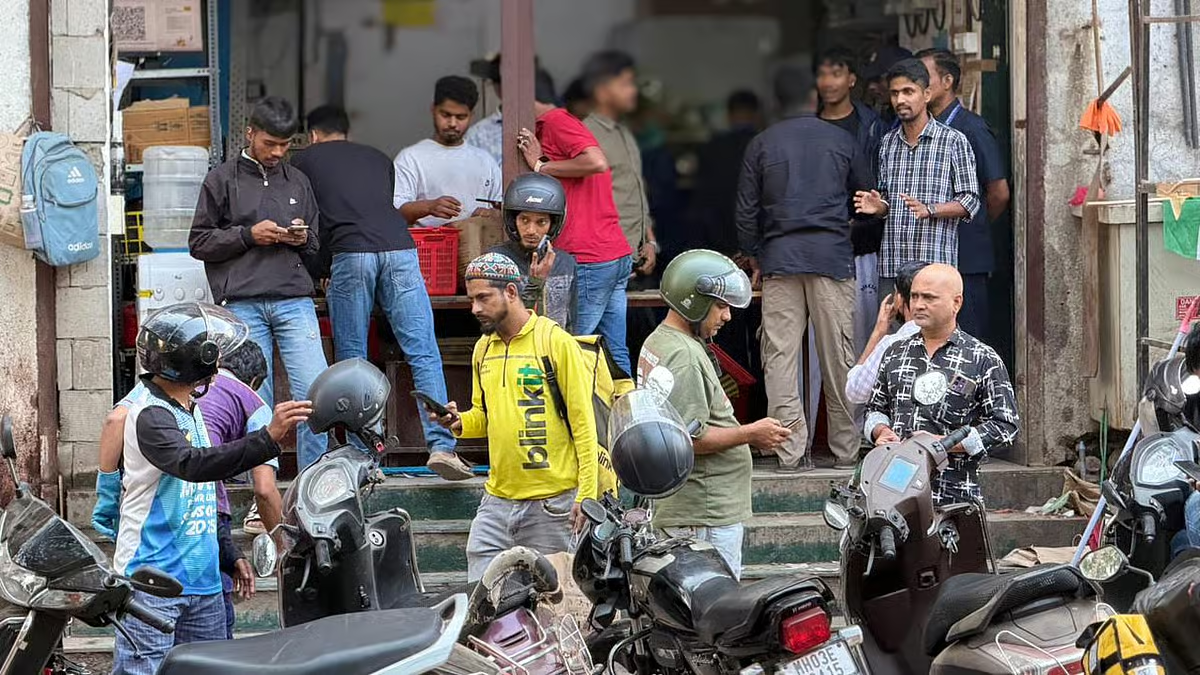
Quick-commerce platform Blinkit has dropped its much-publicised '10-minute delivery' branding, a move that has sparked fresh debate around hyper-fast deliveries, rider safety and gig work conditions in India.
For customers, the announcement has raised a straightforward question: Will my groceries now take longer to arrive? The answer, in most cases, is no — because they rarely arrived in 10 minutes to begin with.
More than a service promise, the 10-minute tag was a branding exercise that helped Blinkit and rivals carve out a distinct identity in the crowded quick-commerce space. Its removal is less about changing operations and more about changing perception.
How Quick Commerce Actually Delivers So Fast
Contrary to popular belief, speed in quick commerce is not driven by delivery partners racing against the clock. The real engine is the dense network of dark stores — small, hyperlocal warehouses embedded within residential or mixed-use neighbourhoods.
Platforms like Zepto and Swiggy Instamart operate on the same principle. Orders placed on the app are automatically routed to the nearest dark store, where staff pick and pack items — often within two to three minutes.
The shorter the distance between your home and the dark store, the faster the delivery. That’s the real secret behind '10-minute' commerce.
Zomato founder Deepinder Goyal has previously explained that delivery partners are not shown countdown timers or delivery deadlines. According to him, the average rider travels under two kilometres at roughly 15 kmph, well within normal city driving speeds.
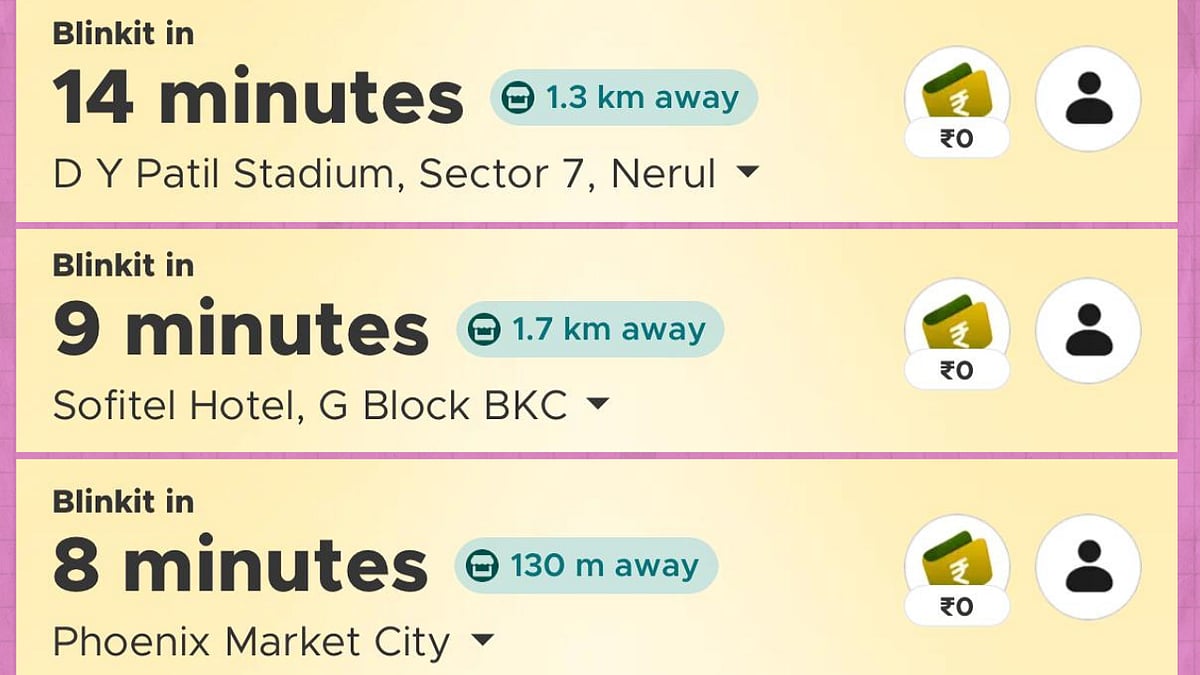
Blinkit delivery times in common Mumbai locations at 9:30 am on Wednesday. (Image: NDTV Profit)
Why '10-Minute Delivery' Was Always A Myth
The reality is that 10-minute delivery only works for a subset of customers.
If you live 500-700 metres from a dark store, your order may indeed arrive in under 10 minutes. But for customers located 1.5–2 kilometres away, delivery times typically range between 15 and 20 minutes.
Examples from app checks show:
In Mumbai, locations show deliveries within 10 minutes, both with stores that are 100 metres or 1.6 kilometres away.
A South Delhi location with a dark store 650 metres away sees deliveries close to 10 minutes, and another location 1.6 km away averages 15 minutes.
In parts of Mumbai and Bengaluru, estimated delivery times often stretch to 17–19 minutes during surge hours.
So when Blinkit drops the 10-minute branding, many customers — especially those farther from dark stores — are unlikely to notice any difference at all.
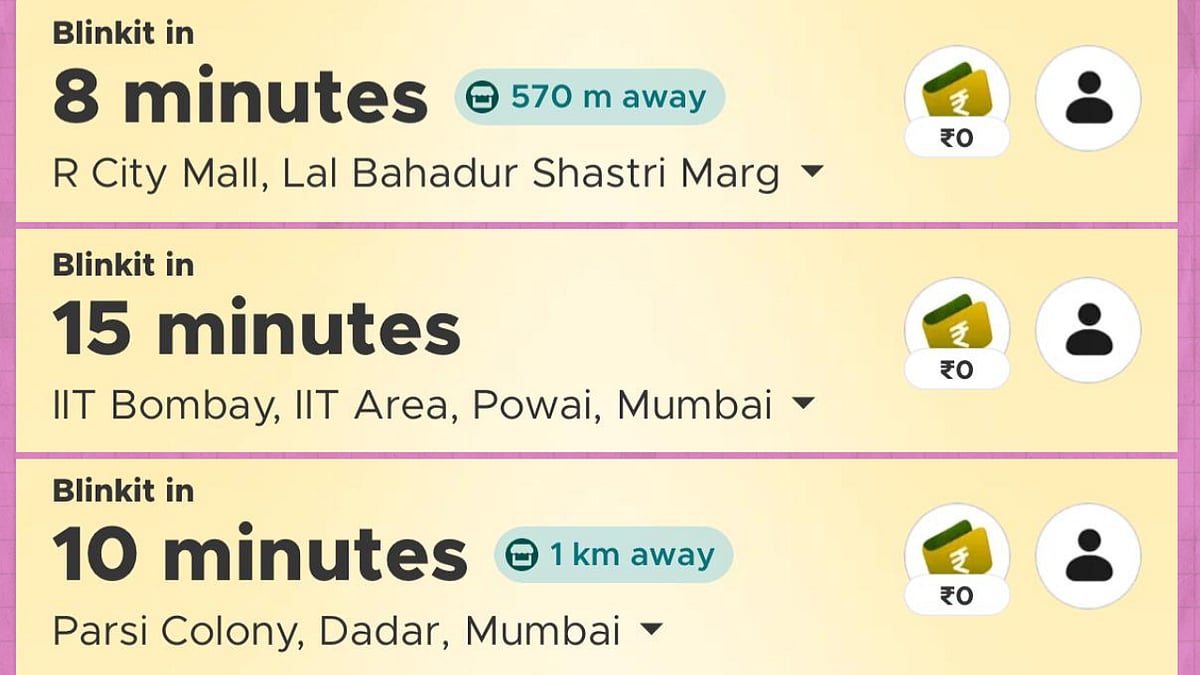
Blinkit delivery times in common Mumbai locations at 9:30 am on Wednesday. (Image: NDTV Profit)
Why Do Riders Still Rush?
The sight of delivery partners weaving through traffic remains common in Indian cities. If the app isn’t pushing riders to race, why does this persist?
Gig worker unions argue the answer lies in income insecurity. Riders are paid per order and often work 12–14 hours a day to earn around Rs 25,000 a month. Completing more orders faster can mean the difference between meeting daily targets or falling short.
This pressure came to a head during the Christmas and New Year’s Eve period.
ALSO READ
No More 10-Minute Delivery: Government Asks Blinkit, Zomato, Delivery To Drop Delivery Time Limit
Government Intervention
More than a lakh gig workers across 22 cities participated in strikes during Christmas and New Year’s Eve, organised by groups including the Indian Federation of App-Based Transport Workers (IFAT) and the Telangana Gig and Platform Workers Union (TWGPU).
Soon after, the labour ministry issued a directive asking quick-commerce companies to strike down the '10-minute delivery' feature.
Sheikh Salauddin, general secretary of IFAT and founder-president of TWGPU, described the move as a victory for gig workers.
"This shows the strength of the workers and the workers’ voice," Salauddin told NDTV Profit, thanking the labour minister for responding to the protests.
He said unions are now consulting workers 'back-to-back' on the government’s proposal under the Social Security Code 2020, which suggests a 90-day annual work threshold to access social security benefits. Draft rules were published on Dec. 31, 2025.
Salauddin also dismissed claims that scrapping ultra-fast delivery would hurt job creation. He added that delivery platforms should compete on discounts and service — not unrealistic delivery speeds.
ALSO READ
Christmas, New Year Eve Strikes Yielded Success: Gig Workers' Union Chief On 10-Minute Delivery Ban
What Actually Changes Now
For customers, delivery times are unlikely to shift in any meaningful way. The same dark stores, the same distances and the same delivery logic remain in place.
For delivery partners, the branding change may slightly reduce pressure created by unrealistic expectations, but it does not address deeper structural issues around pay, security and algorithmic control.
The real impact may be psychological. Marketing shapes behaviour, and removing the explicit '10-minute' promise could slowly reset consumer expectations built over years of instant gratification.
But operationally, the system remains the same. The 10-minute delivery was always more myth than mandate, and dropping the tagline doesn’t change that reality.