Scan to Download
If things pan out as the Reserve Bank of India has projected, the era of 50-basis-point rate hikes is over, Deputy Governor Michael Patra says. Still, the central bank cannot take the foot off the brake because inflation is likely to average 5%-5.4% in FY24.
"We must guide inflation to a stage where it is stable at those levels," Patra says. "We must then guide inflation to 4%, until which point we have to stay on our toes."
The Reserve Bank of India must shepherd inflation to bring about a durable decline, Deputy Governor Michael Patra says.
"The battle against inflation is far from over," Patra says. We remain on guard, far from neutral until we see durable decline in inflation."
What's crucial to note is that the RBI has reduced the size of the repo rate hike, which unfortunately has been priced in, the deputy governor says.
"The moderation of inflation will be very grudging, very uneven," he says. "We must shepherd inflation -- first firmly into the tolerance band (2%-6%) and then to the target."
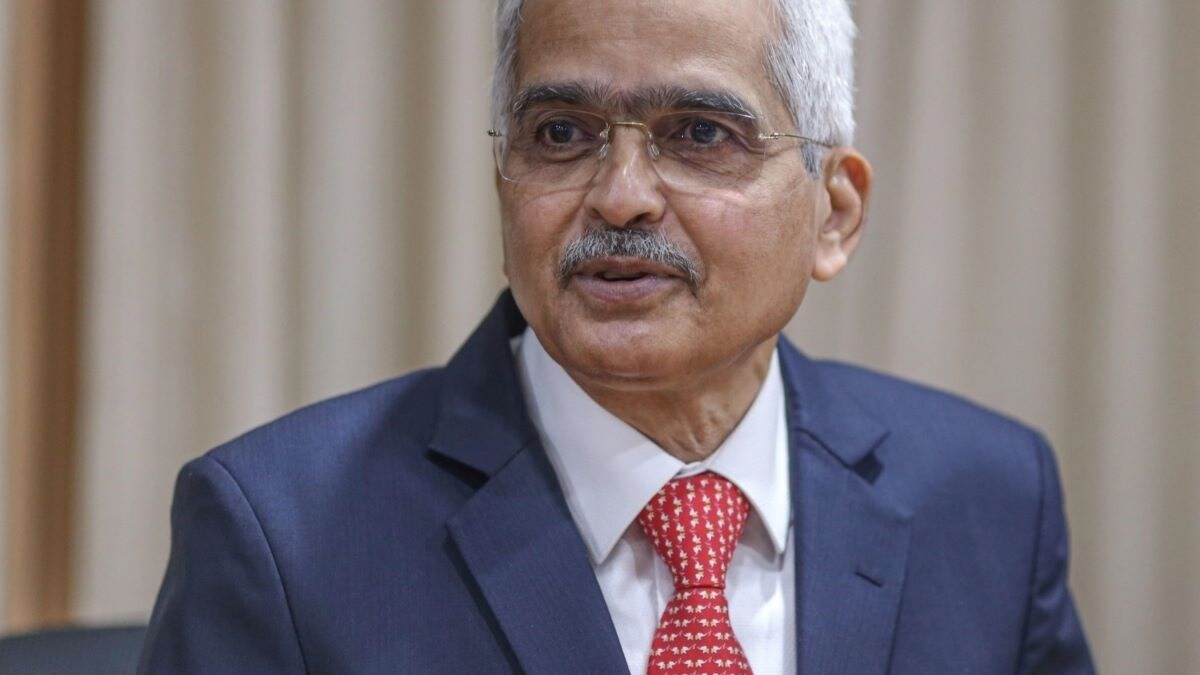
The consideration for formulation of monetary policy is growth and inflation, RBI Governor Shaktikanta Das says when asked whether the central bank adjusts its policy with an eye on foreign exchange rates.
The policy stance is not for exchange-rate management but aimed at preventing volatility in the currency market and attract capital flows. There are measures outside of monetary policy to attract capital flows.
The Reserve Bank of India does not determine policy rates based on actions taken by the US Federal Reserve, Governor Shaktikanta Das says.
The terminal Fed rate is important for the whole world, including India, he says, but RBI’s policy rates are primarily driven by domestic factors.
The worst of inflation is behind us, RBI Governor Shaktikanta Das says at the post-monetary policy conference, underscoring the six key highlights of his policy statement earlier today.
The six key highlights are:
India’s GDP Growth is resilient. It is holding on and doing well in a world of slowing growth.
Headline inflation is moderating... The worst of inflation is behind us. Globally, the same trend is visible.
While inflation is moderating, there is no room for complacency. We have to be watchful, nimble in our actions should it become necessary. The battle on inflation is not over.
We are ready to undertake liquidity operations to inject liquidity but will look for durable signs of turn in liquidity cycle.
Story of Indian rupee is one of resilience and stability. We remain committed to act in event of excessive volatility in currency market.
India's current account deficit is eminently management. Let there be no doubt about it.
Members of India's Monetary Policy Committee, led by RBI Governor Shaktikanta Das, are addressing a post-policy press conference.
Reserve Bank of India Governor Shaktikanta Das ends his policy statement with a quote from Mahatma Gandhi.
“Let no one think that it is impossible because it is difficult. It is the highest goal and it is no wonder that the highest effort should be necessary to attain it.”
The Reserve Bank of India has proposed to enhance the capabilities of the unified payments interface, or UPI, to include single block and multiple debits. That will allow a customer to block funds in her account to be debited as needed.
The Reserve Bank of India has enhanced the held to maturity limits in statutory liquidity ratio to March 31, 2024.
Banks are now allowed to include securities acquired between Sep. 1, 2020 and March 31, 2024, in enhanced limit. The HTM limit will be restored to 19.5% from 23% in a phased manner starting from April-June 2024.
India's forex reserves have increased from $524.5 billion on Oct. 21 to $561.2 billion as on Dec. 2, RBI Governor Shaktikanta Das says.
This covers nine months of projected imports of FY23.
India’s external debt ratios remain low by international standards.
While India's current account deficit is higher than that in FY22, it is still eminently manageable, RBI Governor Shaktikanta Das says.
External sector affected by strong global headwinds.
Slowing global demand weighing on merchandise exports.
Growth of services exports remained robust at 29.1% in H1 FY23.
Meanwhile, remittances are scaling new heights, Das says. India’s remittances are estimated to grow by 12% to $100 billion in FY23, according to World Bank.
The Indian rupee has appreciated against all major currencies, barring a few, RBI Governor Das says. On fiscal basis, the currency has appreciated by 3.2% in real terms.
"The story of the Indian rupee has been one of India’s resilience and stability," Das says. That said, the US Federal Reserve cannot tighten its monetary policy endlessly, Das says. "The terminal rate for the US Fed is anybody’s guess."
The Reserve Bank of India has decided to restore the money market hours to 9:00 am to 5:00 pm, Governor Shaktikanta Das says.
Timings for call action, notive, term money, CP and CD, and repo in the corporate bond market will change. The timings will change for the rupee interest rate derivative trading as well.
There's no let-up in the Reserve Bank of India's efforts to bring inflation to more manageable levels, Governor Shaktikanta Das says.
India's GDP growth continues to maintain resilience.
GDP growth of 6.8% is strong growth impulse.
Battle against inflation has to continue.
"We will monitor all incoming data and assess future outlook (on inflation)," Das says. "RBI to stand ready to act as required from time to time."
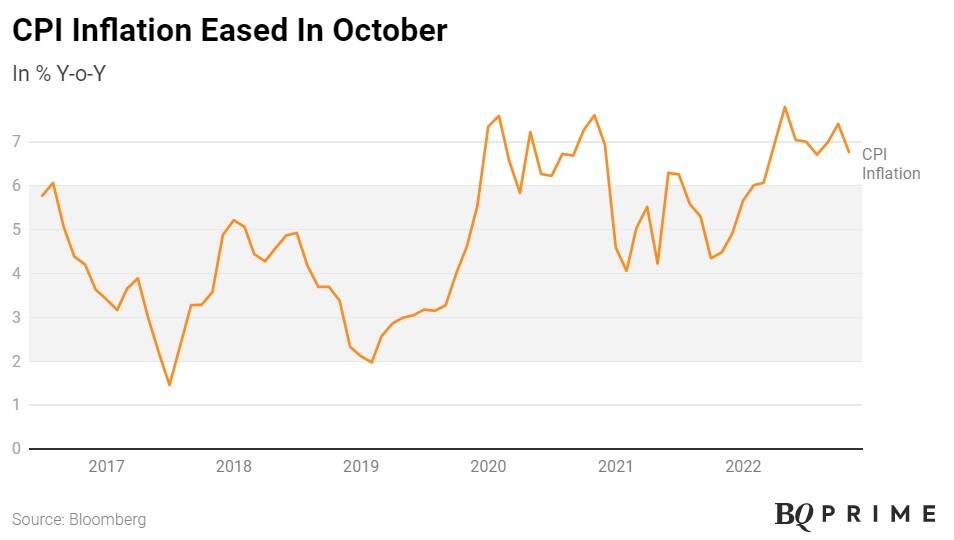
India's inflation rate is likely to remain elevated for the rest of the fiscal ending March 31, 2023, RBI Governor Shaktikanta Das says.
CPI Inflation seen at 6.7% in FY23
CPI inflation seen at 6.6% in Q3 FY23, 5.9% in Q4 FY23
Inflation in Q1 FY24 seen at 5% and at 5.4% in Q2
Average crude oil price estimated at $100 in FY23
Risks on CPI inflation projection are evenly balanced, Das says.
The Reserve Bank of India has moderated its GDP growth expectations for the fiscal ending March 31, 2022.
Real GDP growth for FY23 projected at 6.8% vs 7.0% earlier
India’s real GDP growth seen at 4.4% in Q3 FY23, 4.2% in Q4
Real GDP growth projected at 7.1% in Q1 FY24 and 5.9% in Q2
The risks are evenly balanced, Governor Das says.
India's rural demand is recovering and urban consumption is rising in the aftermath of the pandemic, RBI Governor Shaktikanta Das says.
Non-food bank credit rose by Rs 10.6 lakh crore in April-November 2022, compared with Rs 19 lakh crore last year. The drag from net external demand accentuated in October, even as the agri sector remains resilient.
India's monetary policy committee remains focussed on withdrawl of accommodation, RBI Governor Shaktikanta Das says.
Adjusted for inflation, policy rate still remains accommodative
Over next 12 months inflation expected to remain above 4% target
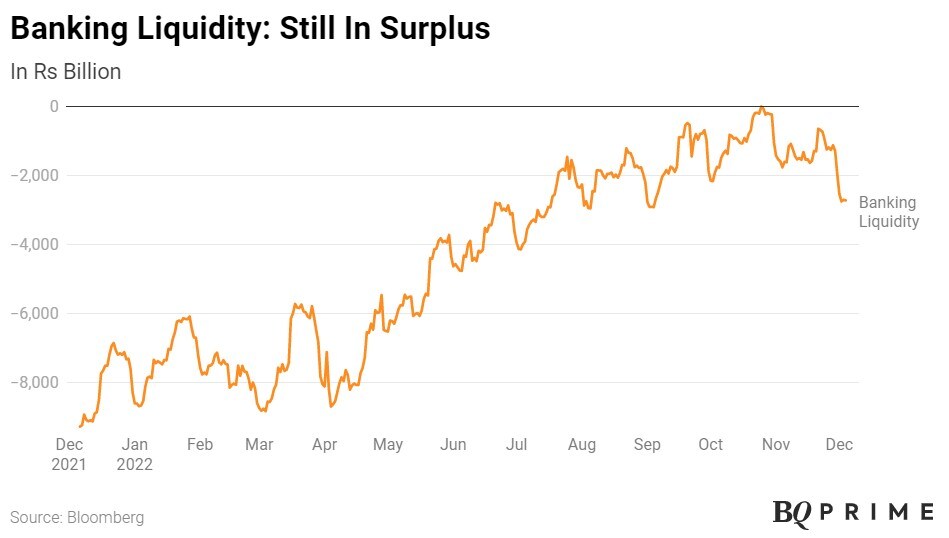
System liquidity remains in surplus with average daily absorption under LAF of Rs 1.6 lakh crore.
The MPC is also of the view that further calibrated monetary policy action is required. The central bank aims to keep inflation expectations anchored, and break the sticky core inflation trends, Das says.
The global economic scenario remains challenging, RBI Governor Shaktikanta Das says in his policy speech.
The global economy is marred by profound shocks, uncertainty
Surges in food, energy prices severely affected poor across world
Inflation remains high, broad-based globally
Emerging market economies have been worst affected
Supply chains are being redrawn based on reshoring, friend-shoring
Food, energy security and climate change are biggest challenges to world, the governor says.
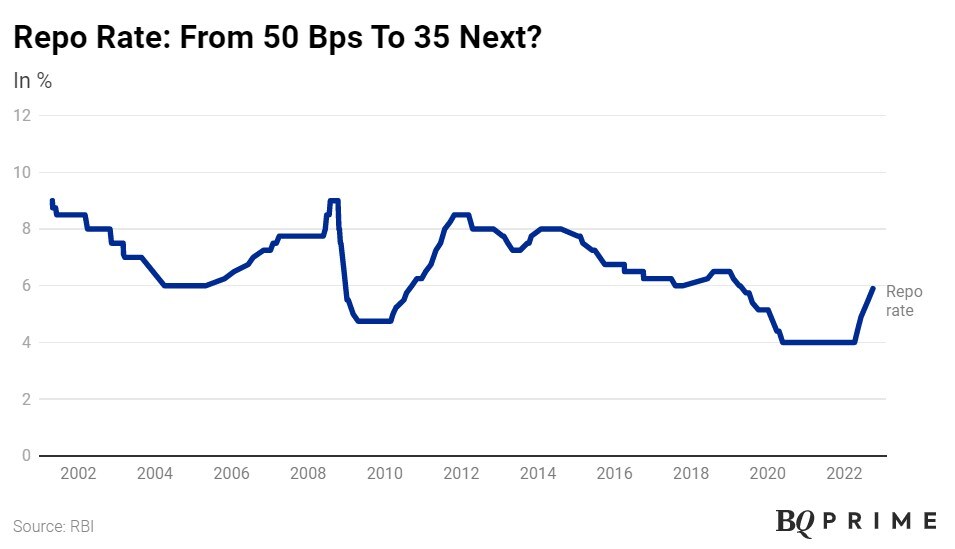
The Reserve Bank of India has increased the benchmark repo rate by 35 basis points to 6.25%.
India’s inflation remains elevated as in most parts of the world
MPC decided by 5:1 majority to increase repo rate by 35bps
4 out of 6 members decided to remain focussed on withdrawal of accommodation.
The policy stance remains accommodative.
The Indian benchmark indices opened flat ahead of RBI's latest monetary policy announcement.
The S&P BSE Sensex opened 0.02% lower at 62,615.52 points while the broader NSE Nifty 50 declined 4 points to 18,642.75.
The rupee fell as much as 15 paise to 82.76/dollar -- the lowest since Nov. 3. The bond yield on ten-year paper declined 1 basis point to 7.23%.
The Indian economy expanded at a slower pace in July-September as the base normalised. The gross domestic product, or GDP, grew 6.3% year-on-year in the second quarter of FY23, compared with 13.5% in the first quarter, according to official data released last week.
Between December and February, the headwinds to growth may become more evident, and given the lags in monetary policy transmission, the MPC may decide not to hike further.
"For another rate hike to happen in February, post the December meeting, the inflation outlook has to deteriorate meaningfully and significant depreciation pressure on the rupee has to re-emerge," Das of Deustche Bank said. "So the bar for a rate hike in February will be high."
Essential Business Intelligence, Continuous LIVE TV, Sharp Market Insights, Practical Personal Finance Advice and Latest Stories — On NDTV Profit.