
PM Modi, President Murmu Congratulate ISRO
Aditya-L1 Starts Power Generation
Aditya-L1 has started generating power after it deployed its solar panels, ISRO announced. The first Earth-bound firing to raise the orbit is scheduled for Sept. 3 around 11:45 am IST.
'All The Best, Aditya L1': ISRO Chief
The Aditya L1 spacecraft has been ejected in an elliptical orbit... I want to congratulate PSLV to put it into right orbit. It's a very long journey of almost 125 days. Let us wish all the best to Aditya spacecraft!ISRO Chairman S Somanath
The Aditya L1 spacecraft has been ejected in an elliptical orbit... I want to congratulate PSLV to put it into right orbit. It's a very long journey of almost 125 days. Let us wish all the best to Aditya spacecraft!ISRO Chairman S Somanath
Aditya L1 MISSION ACCOMPLISHED: Separation Stage Complete
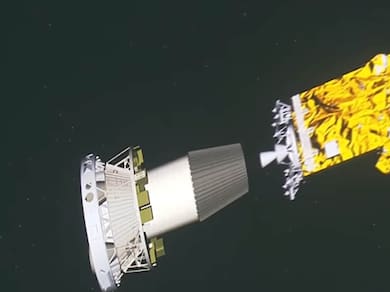
Aditya-L1 spacecraft successfully separated from PSLV rocket, announced ISRO.
Aditya-L1 spacecraft successfully separated from PSLV rocket, announced ISRO.
Separation Event Of Aditya L1 Awaited
Aditya L1: Thrust Cut-off For Fourth Stage Achieved
Aditya L1: Watch The Moment It Took Off
'To the stars!': European Space Agency After Aditya-L1 Launch
Aditya L1: Two Stages Completed, Third Underway
Aditya L1 Takes Off On A 125 Day Journey
Aditya L1, India's maiden solar mission, launched from Satish Dhawan Space Centre (SDSC) SHAR in Sriharikota, Andhra Pradesh.
Aditya L1, India's maiden solar mission, launched from Satish Dhawan Space Centre (SDSC) SHAR in Sriharikota, Andhra Pradesh.
Aditya L1, India's maiden solar mission, launched from Satish Dhawan Space Centre (SDSC) SHAR in Sriharikota, Andhra Pradesh.
Aditya L1, India's maiden solar mission, launched from Satish Dhawan Space Centre (SDSC) SHAR in Sriharikota, Andhra Pradesh.
Aditya L1: Senior Scientists, Union Minister Present
Senior ISRO scientists as well as Union Minister Jitendra Singh and thousands of spectators have gathered to witness the launch.
Senior ISRO scientists as well as Union Minister Jitendra Singh and thousands of spectators have gathered to witness the launch.
Senior ISRO scientists as well as Union Minister Jitendra Singh and thousands of spectators have gathered to witness the launch.
Senior ISRO scientists as well as Union Minister Jitendra Singh and thousands of spectators have gathered to witness the launch.
Senior ISRO scientists as well as Union Minister Jitendra Singh and thousands of spectators have gathered to witness the launch.
Senior ISRO scientists as well as Union Minister Jitendra Singh and thousands of spectators have gathered to witness the launch.
Senior ISRO scientists as well as Union Minister Jitendra Singh and thousands of spectators have gathered to witness the launch.
Senior ISRO scientists as well as Union Minister Jitendra Singh and thousands of spectators have gathered to witness the launch.
Aditya L1 Prepares For Historic Launch
The distance of 1.5 million km to L1 point will be covered in nearly four months (125 days).
The distance of 1.5 million km to L1 point will be covered in nearly four months (125 days).
The distance of 1.5 million km to L1 point will be covered in nearly four months (125 days).
The distance of 1.5 million km to L1 point will be covered in nearly four months (125 days).
WATCH: ADITYA L-1 MISSION LIVESTREAM
Aditya-L1 will be the first space-based Indian mission to study the Sun. The mission is scheduled to be launched at 11:50 a.m. from the Sriharikota spaceport in Andhra Pradesh.
Aditya-L1 Payload To Send 1,440 Images Per Day
The Visible Emission Line Coronagraph (VELC), the primary payload of Aditya L1 will be sending 1,440 images per day to the ground station for analysis on reaching the intended orbit, according to its key scientist.
"From the continuum channel, which is the imaging channel, an image will come -- one image per minute. So approximately 1,440 images for 24 hours, we will be receiving at the ground station," Aditya L1 Project Scientist and Operation Manager for VELC Dr Muthu Priyal said, reported PTI.
IIA will host the VELC Payload Operations Centre (POC), which will receive raw data from ISRO's Indian Space Science Data Centre (ISSDC), process them further to make it suitable for scientific analysis, and send it back to ISSDC for dissemination.
Aditya L1 Payload Summary
The Aditya L1 spacecraft carries seven payloads to observe the photosphere, chromosphere and the outermost layers of the Sun (the corona) using electromagnetic and particle and magnetic field detectors.
Using the special vantage point L1, four payloads will directly view the Sun and the remaining three payloads will carry out in-situ studies of particles and fields at the Lagrange point L1, thus providing important scientific studies of the propagatory effect of solar dynamics in the interplanetary medium.
The suits of Aditya L1 payloads are expected to provide most crucial information to understand the problem of coronal heating, coronal mass ejection, pre-flare and flare activities and their characteristics, dynamics of space weather, propagation of particle and fields etc.
The Aditya L1 spacecraft carries seven payloads to observe the photosphere, chromosphere and the outermost layers of the Sun (the corona) using electromagnetic and particle and magnetic field detectors.
Using the special vantage point L1, four payloads will directly view the Sun and the remaining three payloads will carry out in-situ studies of particles and fields at the Lagrange point L1, thus providing important scientific studies of the propagatory effect of solar dynamics in the interplanetary medium.
The suits of Aditya L1 payloads are expected to provide most crucial information to understand the problem of coronal heating, coronal mass ejection, pre-flare and flare activities and their characteristics, dynamics of space weather, propagation of particle and fields etc.
-
Visible Emission Line Coronagraph (VELC)
-
Solar Low Energy X-ray Spectrometer (SoLEXS)
-
Plasma Analyser Package for Aditya (PAPA)
-
High Energy L1 Orbiting X-ray Spectrometer (HEL1OS)
-
Solar Ultra-violet Imaging Telescope (SUIT)
-
Aditya Solar wind Particle Experiment (ASPEX)
-
Magnetometer (MAG)
Aditya L1 Trivia: Which Other Space Agencies Have Explored The Sun?
The Sun, the closest star to us and the source of all energy and therefore life on Earth, lays at the core in the fields of astronomy and physics. The Sun has been studied both from missions in space and through observatories on Earth.
United States
U.S. space agency NASA, launched the Parker Solar Probe in August 2018. In December 2021, Parker flew through the Sun's upper atmosphere, the corona, and sampled particles and magnetic fields there. This was the first time ever that a spacecraft touched the Sun, according to NASA's official website.
Europe
The European Space Agency (ESA) launched Proba-2 in October 2001. Proba-2 is the second of the Proba series. Proba stands for Project for On-Board Autonomy.
China
In 2022, the Advanced Space-based Solar Observatory (ASO-S) was launched. The observatory is reportedly placed in an orbit about 720 kilometers above the planet.
Aditya L1 Mission Trajectory
The 1,480 kg spacecraft will be put in a highly elliptical orbit of 235 km x 19,500 km around the Earth. The PSLV-C57, which has six solid fuel-based boosters, will take just over an hour to place the satellite in orbit.
The orbit as well as the velocity of the spacecraft will then be increased till it is slingshot towards the Sun.
The 1,480 kg spacecraft will be put in a highly elliptical orbit of 235 km x 19,500 km around the Earth. The PSLV-C57, which has six solid fuel-based boosters, will take just over an hour to place the satellite in orbit.
The orbit as well as the velocity of the spacecraft will then be increased till it is slingshot towards the Sun.
Aditya L1 To Ride Onboard PSLV-C57
PSLV-C57 is the 59th flight of the Polar Satellite Launch Vehicle and 25th mission using PSLV-XL configuration. PSLV is considered as ISRO's workhorse when it comes to launching space missions.
PSLV-C57 will launch Aditya-L1 spacecraft in a highly eccentric Earth bound orbit. The spacecraft will perform orbital maneuvers by using its LAM to reach Sun-Earth Lagrange point L1.
PSLV-C57 is the 59th flight of the Polar Satellite Launch Vehicle and 25th mission using PSLV-XL configuration. PSLV is considered as ISRO's workhorse when it comes to launching space missions.
PSLV-C57 will launch Aditya-L1 spacecraft in a highly eccentric Earth bound orbit. The spacecraft will perform orbital maneuvers by using its LAM to reach Sun-Earth Lagrange point L1.
Aditya-L1 Mission Objectives
The major science objectives of Aditya-L1 mission are:
Study of Solar upper atmospheric (chromosphere and corona) dynamics.
Study of chromospheric and coronal heating, physics of the partially ionized plasma, initiation of the coronal mass ejections, and flares.
Observe the in-situ particle and plasma environment providing data for the study of particle dynamics from the Sun.
Physics of solar corona and its heating mechanism.
Diagnostics of the coronal and coronal loops plasma: Temperature, velocity and density.
Development, dynamics and origin of coronal mass ejections.
Identify the sequence of processes that occur at multiple layers (chromosphere, base and extended corona) which eventually leads to solar eruptive events.
Magnetic field topology and magnetic field measurements in the solar corona .
Drivers for space weather (origin, composition and dynamics of solar wind.
L1 Has Other Occupants Too
Aditya L1 will be placed in a halo orbit around the Lagrangian Point 1 (L1), which is 1.5 million km from the Earth in the direction of the Sun. It will revolve around the Sun with the same relative position and hence can see the Sun continuously.
For common understanding, L1 is a location in space where the gravitational forces of two celestial bodies, such as the Sun and Earth, are in equilibrium. This allows an object placed there to remain relatively stable with respect to both celestial bodies.
These points in space can be used by spacecraft to reduce fuel consumption needed to remain in position.
Aditya L1 will be placed in a halo orbit around the Lagrangian Point 1 (L1), which is 1.5 million km from the Earth in the direction of the Sun. It will revolve around the Sun with the same relative position and hence can see the Sun continuously.
For common understanding, L1 is a location in space where the gravitational forces of two celestial bodies, such as the Sun and Earth, are in equilibrium. This allows an object placed there to remain relatively stable with respect to both celestial bodies.
These points in space can be used by spacecraft to reduce fuel consumption needed to remain in position.
Of the five Lagrange points, three are unstable and two are stable. The unstable Lagrange points are labeled L1, L2 and L3 while the stable ones are labeled L4 and L5, according to NASA.
Aditya L1: When And Where To Watch Live Telecast
ISRO in a post on X (formerly Twitter) said that DD National TV channel will live telecast the Aditya L1 Mission launch from 11:20 am.
The space agency will livestream the launch of Aditya L1 on its official website at isro.gov.in. The live stream will also be available on ISRO's Facebook page and YouTube channel.
Viewers can watch the Aditya L1 live stream in the embedded link below:
Aditya L1 Mission: All You Need To Know
As per information on ISRO's website, Aditya L1 shall be placed in a halo orbit around the Lagrange point 1 (L1) of the Sun-Earth system, which is about 1.5 million km from the Earth.
A satellite placed in the halo orbit around the L1 point has the major advantage of continuously viewing the Sun without any occultation/eclipses, ISRO said.
This will provide a greater advantage of observing the solar activities and its effect on space weather in real time.
Aditya L1 spacecraft carries seven payloads to observe the photosphere, chromosphere and the outermost layers of the Sun (the corona) using electromagnetic and particle and magnetic field detectors.
Using the special vantage point L1, four payloads directly view the Sun and the remaining three payloads carry out in-situ studies of particles and fields at the Lagrange point L1, thus providing important scientific studies of the propagatory effect of solar dynamics in the interplanetary medium.
The suits of Aditya L1 payloads are expected to provide most crucial information to understand the problem of coronal heating, coronal mass ejection, pre-flare and flare activities and their characteristics, dynamics of space weather, propagation of particle and fields etc, ISRO stated.
Aditya-L1 Mission: ISRO's Next Big Leap
After the triumphant success of Chandrayaan-3, the Indian Space Research Organisation is gearing up for the launch of its debut solar mission today.
Aditya-L1 will be the first space-based Indian mission to study the Sun. The mission is scheduled to be launched at 11:50 a.m. from the Sriharikota spaceport in Andhra Pradesh.
The Aditya-L1 spacecraft is designed for providing remote observations of the solar corona and in situ observations of the solar wind at L1 (Sun-Earth Lagrangian point), which is about 1.5 million kilometres from earth.
Aditya-L1 will stay approximately 1.5 million km away from Earth, directed towards the Sun, which is about 1% of the Earth-Sun distance. The Sun is a giant sphere of gas and Aditya-L1 would study its outer atmosphere.