
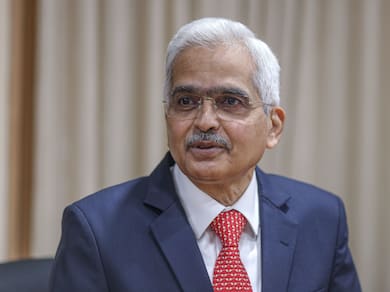
The path to neutral rates a two-milestone journey, RBI Deputy Governor Michael Patra says.
“The path to neutral rates is a two-milestone journey. The first milestone is when inflation falls into the tolerance band. Second is when it aligns with the target," he says.
The full impact of rate hikes should show up by October or November this year, RBI Governor Shaktikanta Das says in a post-policy press conference.
"For the impact of the rate action we have take from April, we will have to wait till October or November to assess full impact," he says. "Usually, rate hikes take 6-8 months for the full impact."
It is not possible to provide forward guidance on monetary policy, RBI Governor Shaktikanta Das says.
"We are on a cycle of rate hikes, and given the level of uncertainty, I would not venture to provide forward guidance," he says. "It is easier to provide guidance on a rate-cutting cycle."
Forward guidance is withdrawal of accommodation.
We don’t have a level for the rupee in mind, RBI Deputy Governor Michael Patra says in the post-monetary policy press conference. "We watch the departure from the mean to judge volatility and take actions in accordance," he says.
India will be impacted by what’s happening globally, RBI Governor Shaktikanta Das says at a post-monetary policy press conference.
"We are living in a globalised world and India will be impacted by what’s happening globally," he says. "Not necessary that we will be isolated from what’s happening worldwide."
India's current account deficit is likely to remain at sustainable levels, RBI Governor Shaktikanta Das and RBI Deputy Governor Michael Patra say at the post-monetary policy press conference.
CAD likely to remain at sustainable levels as per RBI’s forecasts.
Cannot spell out forecast for current account deficit.
Two months of trade data cannot be extrapolated to current account deficit for the full year, Patra says.
Banks will likely pass on repo rate hikes to deposit rates, RBI Governor Shaktikanta Das says in a post-monetary policy press conference.
Banks have already begun to pass the impact of rate hikes.
Trend is expected to continue.
Banks will take efforts to mobilise more deposits.
Fifty basis-point rate hikes have become the new normal, RBI Governor Shaktikanta Das says.
RBI decisions primarily driven by domestic factors, but 50 basis points has become the new normal.
A large number of central banks are hiking by 75-100 basis points.
"We factor in the impact of rate hikes on demand. We have taken a balanced call on the basis of prevailing growth and inflation dynamics," the governor says.
A resilient economy is giving us the space to act on inflation with an eye on growth, says RBI Governor Shaktikanta Das.
Liquidity is gradually reducing and RBI will conduct fine tuning operations on both sides.
Current account deficit manageable and reserve cover remains strong.
Monetary policy will be calibrated, measured and nimble.
Retail inflation has peaked, but remains high, RBI Governor Shaktikanta Das says in a post-policy press conference.
There are signs CPI inflation has peaked and is expected to moderate going into the fourth quarter this year and the first quarter next fiscal year, he says.
But it remains uncomfortably high and monetary policy has to act, he says.
The Reserve Bank of India proposes to enable standalone primary dealers to offer all forex market-making facilities.
Standalone primary dealers can offer all forex market-making facilities as permitted for Category-1 authorised dealers.
To permit SPDs to deal in offshore rupee overnight index swap market.
The central bank will issue draft master direction in managing risks and code of conduct in outsourcing of financial services, Das says.
RBI will also allow cross-border inward bill payments, and NRIs to pay bills for family members in India through Bharat Bill Payment System.
The RBI is seized of its role in this critical juncture of the economy, and will persevere in effort to ensure a safe and soft landing, Das says, carrying forward its "whatever it takes" approach into a third year.
The monetary policy should persevere further in stance of withdrawal of accommodation to ensure that inflation moves close to target of 4% over the medium term while supporting growth, the RBI governor says.
A calibrated approach would provide sufficient flexibility to monetary policy in current uncertain environment, he says.
RBI will carry out fine-tuning operations in both directions, depending on evolving liquidity and financial conditions, says Shaktikanta Das.
- RBI will conduct variable repo rate auction and variable reverse repo rate auction to manage evolving liquidity conditions
The Reserve Bank of India sees retail inflation at 6.7% for FY23. The Consumer Price Idex is likely to come in at 7.1% in at 7.1% in Q2 FY23, 6.4% in Q3 FY23, 5.8% in Q4 FY23, with risks evenly balanced.
Price rise is likely to moderate to 5% in Q1 FY24.
June was sixth consecutive month when headline inflation remained above RBI's upper threshold, Das says.
Since last MPC meeting, have had some let up in global commodity prices, especially industrial metals.
Resumption of wheat supply from Black Sea region could help temper international prices.
Advance of the south-west monsoon by and large on track and kharif sowing picked up, says RBI governor.
Huge buffer stocks will provide moderating impact on inflation.
There are mixed signals from rural demand indicators, says RBI governor.
While two-wheeler sales have increased, tractor sales have contracted. High-frequency indicators -- including railway traffic, port traffic, e-way bills and sales of commercial vehicles -- remained robust in June and July.
Capacity utilisation in manufacturing is above its long-drawn average, Das says. Bank credit growth has accelerated to 14% as of July 15.
The Reserve Bank of India has retained its FY23 GDP growth forecast at 7.2% with Q1 GDP growth at 16.2%, Q2 at 6.2%, Q3 at 4.1%, Q4 at 4%.
The Indian economy is likely to grow at 6.7% in Q1 FY24.
Volatility in global financial markets is impinging upon domestic financial markets leading to imported inflation, RBI governor says.
Inflation expected to remain above the upper threshold in Q2 FY23 and Q3 FY23, Das says, adding that a calibrated withdrawal accommodation is warranted.
India's consumer price inflation has eased from its surge in April but remains uncomfortably high and above upper threshold of target, says RBI governor. Inflationary pressures are broad-based and core inflation remains at elevated levels, he says.
India's Monetary Policy Committee has decided to raise the repo rate by 50 basis points with immediate effect, Das says.
The MPC will continue to remain focussed on withdrawing accommodative policies to ensure inflation remains within target while supporting growth, he says.
Successive shocks to the global economy are taking their toll, says RBI Governor Shaktikanta Das says. We are seeing lower growth across geographies, globalisation of inflation coinciding with deglobalisation of trade, he says.
That said, signs of inflation are moderating over the current year, Das says. The current account deficit is expected to remain within sustainable levels.
The Reserve Bank of India could raise interest rates by as much as 35 basis points at the Friday monetary policy review as inflation remains its number one priority, UBS Securities Chief India Economist Tanvee Gupta Jain says in Bloomberg TV interview.
Inflation in India has peaked and should start correcting meaningfully from October onwards, Jain says, but there are too many uncertainties around the corner. “Commodity prices have fallen but can’t ignore rupee depreciation risks," he says.
External sector risks persist and that could pose funding challenge if global financial conditions continue to tighten, Jain says.
The Indian rupee appreciated 44 paise to 79.02 against the US dollar, ahead of RBI's monetary policy decision today. The rate-setting panel is likely to raise the benchmark repo rate by 50 basis points to levels seen before the pandemic.