
HSBC Global Research expects some tax rationalisation— though not large cuts— an export push, better centre-state capex coordination, an extension of employment-linked benefits, and more clarity of structural reforms being pursued, in the upcoming budget.
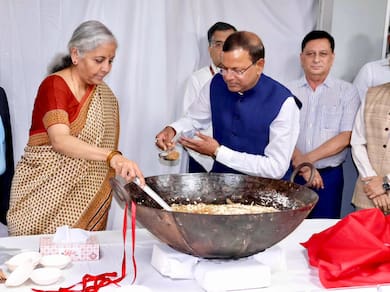
Finance Minister Nirmala Sitharaman attended the traditional 'halwa' ceremony on Friday, marking the start of the final phase in preparing the Union Budget 2025-26.
The Budget is scheduled to be presented on Feb. 1 in the Lok Sabha.
The ceremony was held in the basement of North Block, where the Ministry of Finance is located, with the finance minister and senior officials present.
"We anticipate that the upcoming budget will unleash the immense potential of the pharma sector, projected to reach $130 billion by 2030 and $440 billion by 2047. A streamlined regulatory approval process is essential to enhance investments and productivity," said Sushil Suri, Chairman and Managing Director, Morepen Laboratories.
We urge the government to expand the scope of the Production-Linked Incentive or PLI scheme to make it more accessible for the medical technology sector, thereby boosting our manufacturing capabilities.
Suri hopes for an unified regulatory framework will not only ease business operations but also attract substantial investments, fostering competitiveness within the industry.
"Timely approvals for new drugs, coupled with a focus on R&D investments, will empower companies to innovate and contribute to our goal of becoming self-reliant (Atmanirbhar). We look forward to a budget that prioritises these crucial aspects for the growth of our sector," he said.
Nomura expects that the government might impose higher gold import duties, increase the FDI limit on insurance and encourage capital inflows to support the rupee.
Tax relief measures for lower- and middle-income households are anticipated, which could stimulate discretionary consumption, Bajaj Broking has said in a Budget 2025 expectations note.
Among the income tax relief for the middle class, the government is expected to raise the basic exemption limit under the new tax regime from Rs 3 lakh to Rs 5 lakh.
UBS expects spending on welfare schemes to largely stabilise and increase allocations to boost job creation and skills.
The brokerage further noted that it expects the government to expand the production-linked incentive or PLI scheme to include new sectors in a bid to boost manufacturing, along with other measures.
The impact of the budget on the market has been on a secular decline, albeit actual performance is a function of pre-budget expectations, as per Morgan Stanley. As of now, the market seems to be approaching the budget with skepticism and could be dealing with both volatility and upside risk post budget, if history is a guide.
Morgan Stanley is overweight on financials, consumer discretionary, industrials and technology and underweight all other sectors at the equity market strategy.
"For the market, the key things to watch are the extent of fiscal consolidation, the delta in spends on physical and social infrastructure and sector level incentives/spends," the brokerages.
Nomura noted that repetitive food price shocks have highlighted the importance of raising investment in cold storage and agriculture infrastructure to shield farmers from excessive food price fluctuations. "The budget allocation for agricultural investment should, therefore, rise," the Brokerage emphasised.
UBS expect gross tax revenue collection growth of 11.5-12.0% year-on-year in fiscal 2025-26 (versus 10.7% year-on-year recorded between April and November 2024), in line with the improvement in nominal GDP growth to 10.5% year-on-year in fiscal 2025-26 (versus 9.7% year-on-year in fiscal 2024-25, as per first advance estimate).
Morgan Stanley expects the central government's fiscal deficit target to be set at 4.5% of GDP in F26 versus a lower than target deficit of 4.8% of GDP in F25 (BE of 4.9%).
Mazagon Dock Says Bid For Mega Submarine Deal Under Defence Ministry Review
With Union Budget 2025 round the corner, power sector is hopeful for a preferential treatment this time, to meet the ambitious renewable energy target for 2030.
The industry has sought government intervention to incentivise the grid scale batteries and fast-track the development of battery storage and pumped hydro storage projects in the upcoming budget on priority.
That apart, resolving issues related to transmission infrastructure and evaluating high-end technologies that have high upfront cost are equally critical for long term benefits.
Stirring Up Budget 2025: Halwa Ceremony Explained