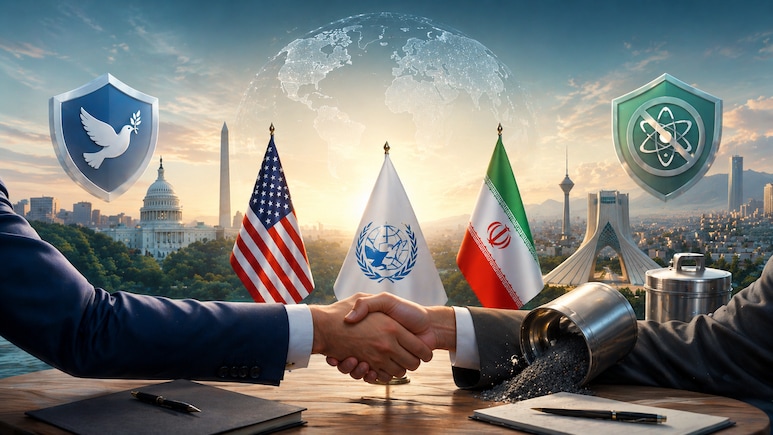
Iran has agreed in principle to give up its stockpile of highly enriched uranium as part of a broader US-led diplomatic framework aimed at easing tensions across West Asia, according to a report by The New York Times citing two US officials. The development marks a potentially significant shift in negotiations between Washington and Tehran after months of escalating regional tensions, military threats and disruption to key maritime trade routes.
While Iranian officials have reportedly agreed in principle to relinquish the uranium stockpile, the exact mechanism for verification, transfer and enforcement remains under negotiation and is expected to be finalised after a formal agreement is signed.
US President Donald Trump said on Truth Social that an agreement between the US, Iran and several regional countries had been “largely negotiated,” though some details were still being worked out. “A finalisation” would be announced shortly, Trump said.
Strait of Hormuz Reopening a Key Part of Talks
A major element of the proposed framework involves restoring maritime stability in the Strait of Hormuz, one of the world's most critical oil shipping routes. Trump said the agreement would result in the reopening of the strait, potentially easing pressure on global energy markets that have been rattled by months of supply disruptions and geopolitical uncertainty.
The diplomatic effort has involved multiple regional players, including Mohammed bin Salman, Recep Tayyip Erdogan and Benjamin Netanyahu, according to statements from the White House.
Pakistan also appears to have played a mediating role, with the country's military describing recent negotiations as “encouraging progress toward a final understanding.”
Key Details Still Unresolved
Despite the diplomatic momentum, major questions remain unresolved, particularly around how Iran's enriched uranium stockpile would be removed, monitored or dismantled.
Iran's semi-official Tasnim News Agency said indirect negotiations over the past 24 hours had narrowed differences between the sides, while consultations continued in Tehran to prevent further escalation.
The proposed agreement is expected to focus on two immediate goals: preventing fresh military conflict and creating a longer-term framework for regional security and maritime stability.
Essential Business Intelligence, Continuous LIVE TV, Sharp Market Insights, Practical Personal Finance Advice and Latest Stories — On NDTV Profit.