Rebel Foods Aims 100 Food Courts In Big Offline Push
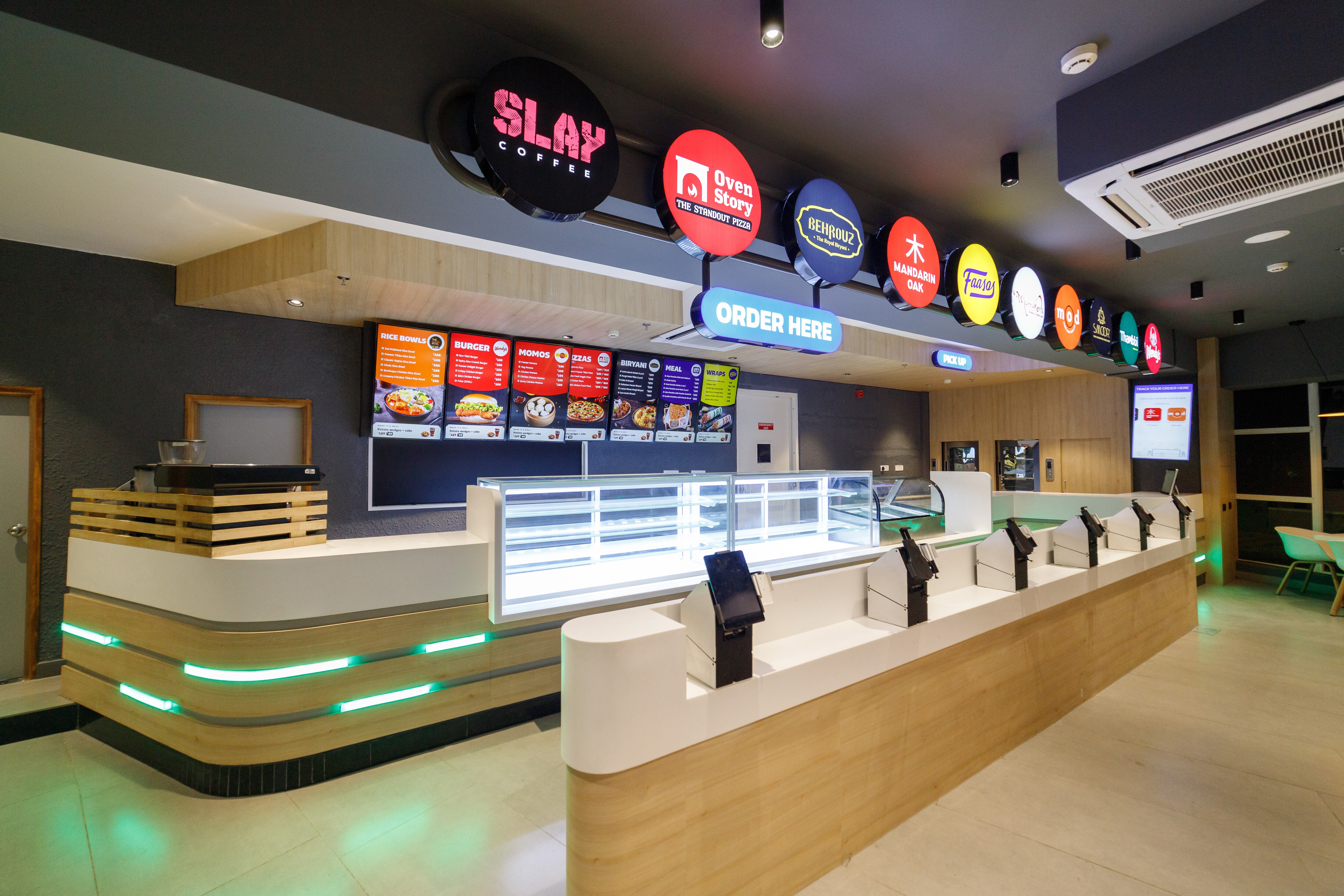
Cloud kitchen operator Rebel Foods Pvt. is looking to set up 100 outlets in two years as the company revisits its offline retail plans in a bid to turn profitable this year.
These outlets will be in a food court format called EatSure, but not resemble traditional restaurant businesses. "They will be smart and unconventional, a first-of-its-kind in India," Rebel Foods co-founder Sagar Kochhar told BQ Prime.
The food court, like its app, will allow customers to place orders through kiosks or by scanning QR codes on the table. One can order from multiple brands in a single time, according to Kochhar.
Once prepared, the order will be notified to customers through the digital screens in store or through a WhatsApp message. Customers can then either choose to dine-in or takeaway, he said.
The food court will house all of Rebel Foods' own as well as partner brands, including Behrouz Biryani, Oven Story Pizza, Faasos, Mad Over Donut, Cafe Goodluck, Wendy's, Thambbi, Lunchbox, Marrakesh, SLAY Coffee, Smoor Chocolates, Zomoz, Firangi Bake and others.
"One can order a plate of biryani from Behrouz, a side from Faasos to a pizza from Oven Story, dessert from Smoor Chocolates and a beverage from Slay Coffee all together in one order without any additional wait or queue," Kochhar said.
He added that unlike the traditional food courts, the company is trying to solve a "broken experience" where customers don't have to order each food category separately from different brands. It is bringing in a queue-less completely-digital ordering experience, easy to track the status of the orders and enjoy together in a group.
"We started our pilot last year and the initial response has been very good, so we are rolling it out nationally," Kochhar said.
Rebel Foods has launched its maiden flagship outlet, spread across 3,000 square feet, in Law College Road, Erandwane in Pune on Wednesday.
"We plan to open about 100 outlets in two years across high-footfall areas like highways, airports and office locations," he said. "We will scale up this format outside India as well depending on consumer response."
The coronavirus pandemic has had a far-reaching impact on consumer habits, changing the way one shops, buys and consumes. If only one sector that has skyrocketed in popularity since the beginning of the pandemic, that is the virtual restaurant sector, driven by the demand for at-home dining and deliveries. But the boost was short-lived. As people start eating out again, the restaurant industry is now shifting towards an omnichannel approach.
"We moved away from offline to focus on cloud kitchen business as it didn't solve any specific problem. But now with the power of technology, we are back offline as omnichannel is the way forward," Kochhar said.
At the heart of this initiative is Rebel Foods' full-stack technology—Rebel OS—through which it helps multiple brands to launch and scale-up.
Through the Rebel Launcher, powered by Rebel OS, the company has launched over 25 brands. Besides its offline format, the EatSure app is creating a similar experience virtually.
Kochhar said that the app has already seen five million downloads across 75 cities.
Currently, the company operates more than 4,000 internet restaurants. With a portfolio of 45 odd brands under its umbrella, including partner brands, it serves 10 countries, including India, Indonesia, the UAE, the UK, Singapore, Malaysia, Thailand, Hong Kong, Philippines and Bangladesh. Rebel Foods also has 450-odd kitchens across geographies.
Kochhar said the plan is to break even by the end of this calendar year as Rebel Foods prepares to list on the bourses in 2024.
Rebel Foods started out as a single-brand QSR chain Faasos before moving to the cloud kitchen format in 2014. It also sells on Zomato and Swiggy, besides its own distribution channel.
The Sequoia Capital-backed firm entered the unicorn club with a $175 million round led by the Qatar Investment Authority in November 2021.
In the 2021-22 financial year, Rebel Foods' revenue jumped 2.1 times to Rs 859 crore. Its losses spiked 54.9% to Rs 564 crore from Rs 364 crore in the 2020-21 fiscal, according to its financial statements with the Registrar of Companies.

-
Navigating Friction And Energy Realities: An Analysis Of Marco Rubio's October Visit To India

Occurring at a critical juncture marked by stalled trade negotiations and escalating geopolitical pressures over global energy supplies, the visit offers a profound window into modern US-India relations.
-
India Exports Capital. Why Not Export Trusteeship?
The big question, then, is whether India can build an institution that global borrowers, investors, banks, and lawyers can trust, even without an Indian connection.
-
France's Economy & Politics Are In Crisis | The Reason Why
Let's look at how the French economy and politics evolved under Nicolas Sarkozy, Franois Hollande and Emmanuel Macron.
-
You May Inherit The Business. You Must Earn Its Credibility.
Succession tests the founder's ability to share authority as much as it tests the next generation's readiness to assume it.
-
Signing Deals Is One Thing; Making Them Work Is Another | The Week In Whys
Sometimes, things don't turn out as planned. Indian companies have lost some bids to rivals, some projects won't produce until 2030.
-
FOMC Wall, PERM Suspension, Hospital Stocks | Talking Points This Week
A PERM suspension would directly affect green-card sponsorship rather than H-1B visas, so the near-term earnings impact could remain relatively limited. The key question is whether this marks a new phase in US scrutiny of Indian IT.
-
Everything, Everywhere, All At Once: Dalal Street's Week To Forget | Joining The Dots
Visa curbs, a Starlink spat and cancer drug caps: what connects this week's shocks for Indian markets
-
India Is Going Abroad For Critical Minerals. But It May Take Years To Pay Off | The Reason Why
Although India's steps are in the right direction, they remain modest compared with India's growing dependence.
-
When Everyone Has AI, What Gives You An Edge?
India's young workforce is entering an uncertain world of work where powerful AI tools are becoming widely accessible. The advantage will belong to those who combine deep expertise with digital fluency, and the distinctly human capabilities that technology cannot manufacture.
-
Wrong Labels, High Pesticide Residues Holding Back Agri Exports | The Reason Why
India needs stronger domestic food-safety and labelling standards, with best practices becoming part of everyday business for farmers, traders and food companies.










